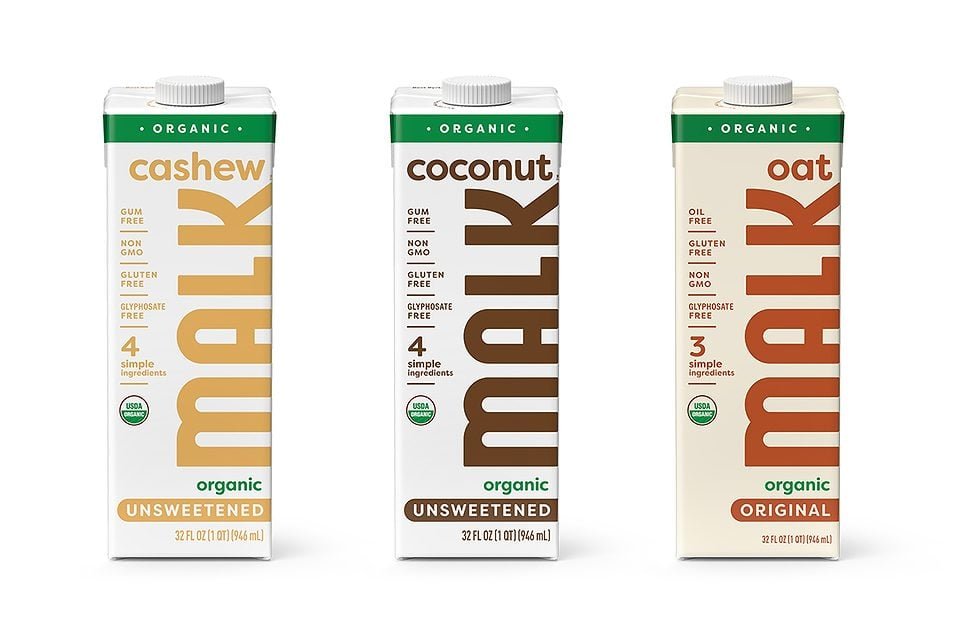
AUSTIN, TEXAS — Malk Organics may be known for what isn’t in its products as for what is. The company develops, produces and markets organic dairy alternatives that don’t contain oils, gums, natural flavors or fillers.
The positioning gradually has been winning over consumers and resulted in what the company calls its “strongest growth stretch” since the privately held and private equity-funded company launched in 2015.
Sales have jumped 29% so far this year, and Malk boasts 46% growth across traditional and mass retail channels. The company’s portfolio consists of 20 products, up from three in 2021, and last year’s sales were reportedly more than $94 million with 1.4 million units sold compared to $64.4 million and about 960,000 units sold in 2024.
Stock-keeping units include unsweetened and flavored almond, oat, cashew, coconut and soy Malk; flavored creamers (including two seasonal offerings); shelf-stable almond, oat, coconut and cashew Malk; and the latest addition, Whole Malk, a blend of coconut, cashew, soy and pea protein with 12 grams of protein per serving.
In addition, the company has entered brand partnerships with Kith Treats, Coconut Cult and Cha Cha Matcha and is the exclusive dairy alternative for Erewhon’s celebrity smoothie collaborations.
“We aren’t growing just to get bigger,” said Ryan Rouse, president. “We’re going everywhere our standard already belongs.”
In an interview with Food Business News, he said “it’s been a pleasant surprise” to find out that Malk could achieve what management thought it could do.
“This company was started 11 years ago, so if you backed all the way up, you’d say it was one of those 10-year classic successes,” he said.
Multifaceted formula for success
Rouse, who joined the company in 2024, said Malk has been able to harness several advantages to reach its current level of performance, including responding to the consumer trend of clean label and transparency, introducing improved packaging, applying the right retailer discounts and closely attending to distribution and the supply chain.
Malk committed to ingredient transparency early on and has stuck to the commitment ever since even as costs have risen.
“The reason other companies put gums and fillers and other things in (their products) is because it’s cheaper,” Rouse said. “Consumers started caring about what’s in their food and in their drinks at a time that we were coming to market and they were willing to pay for it.”
Sustainability is another focus for the company that resonates with some consumers. When Malk works with almond growers, for example, the company makes sure water preservation is a significant part of the operation, Rouse said.
“Retailers care, consumers care and we care,” he said.
Every business that creates a product has some sort of waste involved, he said, so it’s incumbent on them to avoid any unnecessary waste.
“Some consumers become more aware of that than others,” Rouse said. “We’ve done everything we can to work with farms that have the least amount of waste.”

Malk’s latest innovation is a “whole” product formulated with soymilk, coconut milk, cashews and pea protein.
| Photo: Malk OrganicsPlenty of competition
Given the popularity of plant-based beverages, Malk inevitably has competitors among numerous brands also promoting cleaner labels and transparency.
Rouse said Califia Farms is probably the company’s biggest competitor in the space, right now. Other competitors include Three Trees, Mooala, Elmhurst 1925, Nutpods, Ripple Foods, Kite Hill and Good Karma Foods.
Malk’s expanded distribution has proven to be a driver of additional velocity.
“The best marketing you can do is have a brand on shelf at a grocery store,” Rouse said. “It’s best for us to be in the cooler and on the shelf.
“The challenge for food and beverage is limited shelf space, and (retailers) can only fill it with so many products. They have less coolers than they have dry shelf, so it also helps from that perspective.”
Fortunately for Malk, the category’s future looks promising. The global plant-based beverage sector is currently worth $63.21 billion, according to Business Research Insights, and it’s projected to increase by a compound annual growth rate of nearly 13% to hit $173.59 billion by 2035.
What’s next?
While Rouse wouldn’t discuss specific products Malk will be launching in the next year or two, he said they will be products that respond to consumers who want more out of what they consume. The only clue he provided is Whole Malk is part of the plan and of the company’s goal to improve the consumer experience.
Right now, the company’s biggest seller is unsweetened almond followed by vanilla almond. Coconut products that launched last year are also quickly becoming a favorite with many customers, Rouse said.
He called this period “an incredible run” for Malk and said he’s confident employees will look back on this stretch of time as the best.
“You can’t always work for a company with a loyal consumer base and is winning,” he said.
In his view, it’s also important to stop and smell the roses even when everyone is busy attending to the mission.
“I tell my team that if you’re ever having a bad day or week, go read the comments on our socials because they’re filled with a whole bunch of excitement,” Rouse said. “It’s easy to lose sight of that when you’re focused on the day to day.”
#Malk #Organics #moment
About the Author