Unlock the Editor’s Digest for free
Roula Khalaf, Editor of the FT, selects her favourite stories in this weekly newsletter.
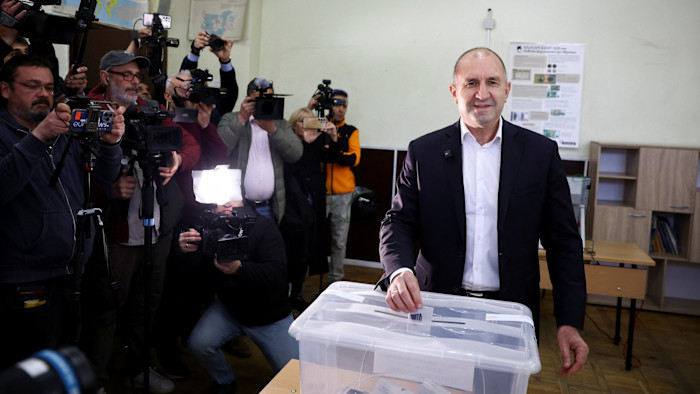
Russia-friendly former president Rumen Radev is on course to win Bulgaria’s parliamentary elections, a result that could push the south-eastern EU and Nato member closer to Moscow.
Radev’s Progressive Bulgaria, a leftist political group, was predicted to win 37.5 per cent of the vote, according to an exit poll by local pollster AlphaResearch published immediately after polling stations closed on Sunday.
The centre-right GERB party of former premier Boyko Borisov was expected to win 16.2 per cent, while its junior partner, the DPS party of US and UK-sanctioned oligarch Delyan Peevski, was on 7.5 per cent. The liberal We Continue the Change (PP-DB) had 14.3 per cent.
Other exit polls gave Radev’s group slightly higher figures of about 39 per cent.
“A coalition government will be needed, but it seems somewhat unlikely and internally unstable,” AlphaResearch director Boriana Dimitrova said before the vote. “Not only because, at the end of the campaign, Radev ruled out any possibility of coalitions . . . but also because there are deep differences.”
The snap election was the country’s eighth in five years. Radev stepped down as president in January to run for the more powerful post of prime minister.
Radev will need at least one coalition partner to form a stable majority of at least 121 MPs in the 240-seat parliament, something analysts warned will not be straightforward given his differences with the other major parties.
His anti-corruption message has alienated GERB and DPS, and his pro-Russia platform has kept the PP-DB group at a distance.
Radev is closer to Russia than any recent Bulgarian premier. During his time as president, he was reluctant to condemn Moscow’s full-scale invasion of Ukraine, criticised EU sanctions and opposed Bulgaria’s accession to the Eurozone.

Valérie Hayer, a French liberal MEP who leads the Renew Europe group in the EU assembly, told the FT she was “very concerned” about Radev winning the election and becoming “Putin’s Trojan horse in Europe”.
That might make it difficult for him to find a common platform with Bulgaria’s mainstream parties, most of which have committed to a pro-western ideology and clashed with Radev on his sceptical attitude to the EU and Nato.
“Bulgaria has the historic opportunity to break once and for all with the Peevski-Borisov model, which we should not miss under any circumstances,” Radev posted on social media in a final swipe at his two main opponents as voting got under way.
“I urge today all Bulgarian citizens in the country or abroad to go out and vote. That’s the only way to . . . take our country back,” he added.
At the closing rally in Sofia on Thursday, the Radev campaign projected a picture of him and Russian President Vladimir Putin as part of a slideshow with other world leaders.
During the campaign Radev told a pro-Kremlin YouTube channel that he intended to be a “very important link . . . to restore relations with Russia”.
That could be problematic for Sofia’s standing in Brussels. Bulgaria exports significant amounts of ammunition to Ukraine and lies along one of the main energy paths supplying central Europe.
Bulgaria, with a population of just under 6.7mn, is also deeply marred by corruption and has struggled to improve the rule of law as one weak government has fallen after another.
Local analysts say that despite his pro-Moscow leanings, Radev is unlikely to turn into a second Viktor Orbán, the longtime Hungarian premier and Kremlin ally who lost his country’s elections a week ago.
Radev was likely to moderate his stance to get sufficient coalition backing to form a government, they said.
But Goran Georgiev, a Russian disinformation expert with the Sofia-based Center for the Study of Democracy, warned that Radev’s ascent signalled creeping Russian influence amid broad public dissatisfaction with the political class.
“With each new election, the pro-Russia vote does increase ever so slightly,” Georgiev said. “Russia knows where its interests are. They can support various parties.”
#ProRussia #expresident #win #Bulgarias #elections
About the Author