KANSAS CITY — During the April 15 Food Business News webinar, Turning Startup Challenges into Growth, five founders shared their origin stories and why they chose to innovate within specific product categories for their brands.
Attendees heard from Nikki Seaman, founder of Freestyle Snacks; Molly Blakeley, founder of Molly Bz; Sophia Cheng, founder and chief executive officer of Oddball; Michael Fedele, founder and CEO of Throne Sport Coffee; and Alexander Harik, founder and CEO of Zesty Z.
 Photo: ©TIERNEY – STOCK.ADOBE.COM
Freestyle Snacks
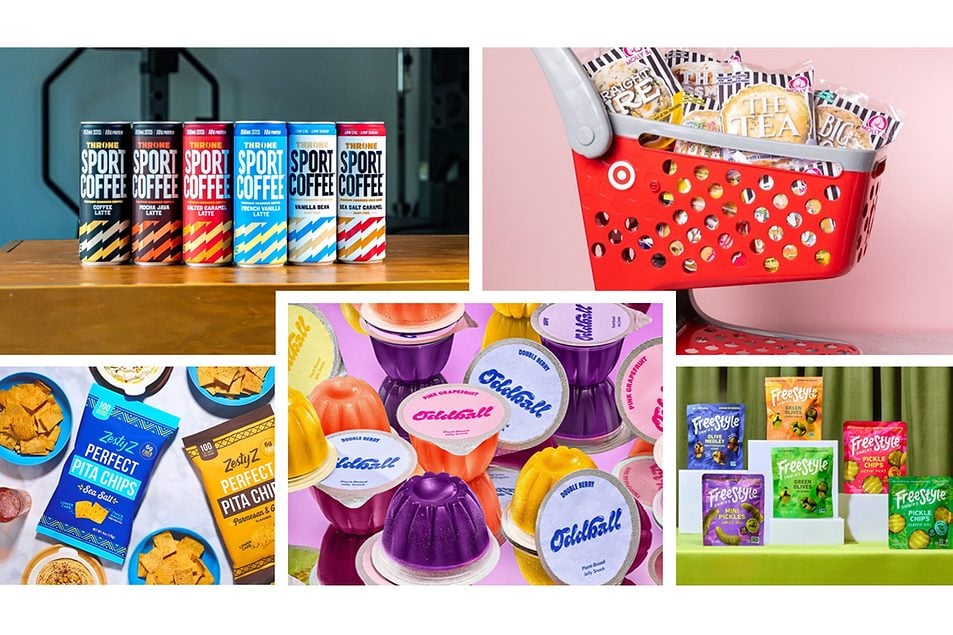
For Seaman, her mission for Freestyle Snacks, an Atlanta-based startup producing on-the-go olive and pickle snacks, is to revolutionize snacking through whole foods.
The company launched direct-to-consumer (DTC) on its website in January 2022 with olive snacks as its first product.
“It was only natural this past fall we expanded into a new product line, outside of just olives into pickle snacks,” Seaman said.
Freestyle Snack’s go-to-market strategy has been focused primarily on retail and wholesale. To date, Freestyle Snacks is available in about 6,000 stores nationwide, with a goal of 10,000 stores by the end of the year.
Molly Bz
Before launching Molly Bz, based in Eagle River, Alaska, in July 2018, Blakeley found herself down to her last $150.
As a single mother with no job and no plan in place, Blakeley put her entrepreneurial skills to the test.
“I started making very weird gourmet cookies,” Blakeley said. “They took off like a rocket.”
Continuing innovation within Molly Bz, Blakeley recently launched its sub brand, The Trashy Gourmet.
The first product Blakeley launched under The Trashy Gourmet was par-baked air fryer cookies.
“The sub brand was something that (came out of) when we were doing all of our Molly Bz indulgent cookies with real butter, real sugar and real eggs, we found that they’re a higher-end cookie and not everyone wants a higher-end cookie,” she said. “And they (grocery stores) were sometimes putting me on shelf next to someone that was using kind of trashier ingredients. I thought, ‘if they’re (consumers) buying it I’ll make it.’ So that’s how we pivoted into The Trashy Gourmet.”
When first developing Molly Bz, Blakeley’s then pre-teen son was involved in the recipe and development phase.
Her now 18-year-old son continues to stay involved in the business. Blakeley attributes his constant use of the air fryer for helping launch the par-baked cookies.
“I’ve watched him and I thought, ‘what can I do so that it would make it so that he can just fry off one cookie and not fry off a whole pack and not have them raw,’” she said.
The Trashy Gourmet is in the frozen section of the grocery store, so Blakeley is focused on earning trust from shoppers in that segment of retail.
“We started out with our big 3 ½-oz indulgence cookies and realized really quickly that in that department (frozen), they’re (consumers) really wanting less than an ounce just to try it,” she said. “And also, not doing something crazy. I’m starting off with a basic chocolate chip cookie and a sugar cookie with sprinkles.”
Oddball
New York-based Oddball has its roots in Cheng’s childhood in Asia where junk food was not commonly found in her pantries.
Upon moving to the US, Cheng said she was free from being told what to eat and what not to eat.
“(In Asia) There wasn’t a lot of the good stuff like Hershey’s, Nerds Ropes, Cheez-It, Oreos, etc.,” she said. “In Asia, our eating habits adhered so much to the basic principals of eating fruit as a snack and desserts in balance and moderation over the extremes. So that really inspired me to think about how I wanted to eat a snack as an adult.”
Cheng brought her childhood principles to life via Oddball in April 2025.
The startup manufactures a line of plant-based jelly snacks formulated with agar, a gelling agent derived from seaweed.
“Oddball is about rethinking what snacking can look like for families today,” she said.
The reason behind using agar instead of traditional gelatin also stems from Cheng’s childhood.
“In Asia we do not use gelatin we use agar,” she said. “It (agar) also means that it’s shelf-stable, right? So, it’s more convenient. We do believe that we’re not the comparison to Jello, we’re more of a shelf-stable fruit snack.”

Oddball manufactures a line of plant-based jelly snacks formulated with agar, a gelling agent derived from seaweed.
| Photo: OddballThrone Sport Coffee
Fedele has been in the beverage industry for approximately 17 years. He started his career at The Coca-Cola Co. as a brand manager for Powerade and later was a senior brand manager for vitaminwater.
“I then met the founder of vitaminwater who at the time in 2012 just invested in a small startup sport drink called BodyArmor,” he said. “I then joined BodyArmor in 2012 as the director of marketing.”
In May 2024, Fedele tapped into his sports nutrition beverage industry knowledge to launch his own endeavor – Throne Sport Coffee.
“You look at all the RTD (ready-to-drink) coffees that are out there and frankly, they’re boring,” he said. “They’re unhealthy, they have boring packaging, they’re not doing anything fun or exciting from a marketing standpoint. And they’re loaded with artificial ingredients, calories and tons of sugar.”
Fedele described Stamford, Conn.,-based Throne Sport Coffee as a line of “better-for-you” RTD cold coffees that are tailored for consumers with active lifestyles.
The company offers a line of lattes that it says are formulated with 150 mg of natural caffeine, Arabic coffee, natural colors, natural flavors, and also feature 10 grams of protein that comes from ultra-filtered lactose-free milk.
The company’s dairy-free cold brews feature 8 grams of cane sugar as well as 100% of your daily vitamin B and are only 50 calories per can, according to Fedele.
“Across the board, we are indeed a better-for-you cold coffee option,” he said.
Patrick Mahomes, NFL quarterback for the Kansas City Chiefs, is the company’s No. 2 shareholder. While Mahomes may be the company’s No. 2 investor, approximately 20 professional athletes have partnered with the brand as well.
“He’s (Patrick) put his own money into the brand, and he is the lead investor in the brand to date,” Fedele said. “He also is the face of the brand from a marketing standpoint.”
Zesty Z
Harik is a two-time founder within the consumer packaged goods (CPG) industry.
His current bet for his startup Zesty Z, New York, is that fiber is the next protein.
Zesty Z launched in April 2024 and makes twice-baked pita chips that feature 6 grams of fiber, 3 grams of protein at 100 calories per serving.
The pita chips are twice baked from freshly made pita bread.

Zesty Z’s high-fiber pita chips are positioned to take advantage of the growing number of GLP-1 consumers seeking extra fiber, said founder Alexander Harik.
| Photo: Zesty Z“There really isn’t another salty snack on the market with those macros,” Harik said. “Here’s what matters even more, we’re here to serve our customers and consumers. And 90% of those consumers don’t get enough fiber. Fiber is one of the most important nutrients that we need for gut health and blood sugar regulation.”
For Zesty Z, Harik believes there is a documented gap and notices there is almost nothing on the salty snack shelf that is addressing these issues for consumers.
“On top of it and what keeps me going and gets us excited is add the layer of the GLP-1 consumers where we believe consumers are going,” he said. “We’re building this brand where consumers are going. We’re not just trying to build a better pita chip; we really are trying to build a fiber-forward snack brand for where consumers are going.”
#Founders #finding #niche #established #categories
About the Author