KANSAS CITY — During the Power of Meat presentation at the 2026 Annual Meat Conference, recalibration was a fitting adjective used to describe the purchasing behavior of today’s retail meat customers. Among the nearly 1,700 consumers surveyed for the report, many referenced how inflation has made it a challenge to put meat and poultry on their family’s plates.
Anne-Marie Roerink, principal of 210 Analytics, presented the findings of the annual study released on March 2 at the event hosted by the Meat Institute and FMI — The Food Industry Association.
“More than anything, we are not seeing people walk away from the meat department, but we are seeing recalibration of spending through money-saving efforts,” she said.
Roerink said the marketplace continues to dictate how retailers engage with consumers shopping in the meat department. Meanwhile, a demographic shift among consumers is afoot and demands the attention of industry stakeholders, in what she referred to as “the changing of the guard.” This shift is demonstrated by findings in the study indicating millennials and Gen Z accounted for 67% of the meat department unit growth for 2025, with millennial spending expected to overtake Boomers’ spending in the next two years.
Part of that change is fueled by evidence that a leading source of meal planning and purchases for younger consumers are inspired by social media and online sources.
“The younger you go, the more the inspiration tends to come from those digital sources,” Roerink said.
She also said artificial intelligence (AI) is playing a bigger role in consumers’ shopping habits and meal preparation. Roerink said 15% of consumers in the study were using it for meal planning and that trend is expected to increase exponentially in the future.
“Keep in mind that as brands and as retail stores, it is AI that is going to decide what is on a person’s dinner plate,” she said.
While much of the inspiration may come from online sources, the study found 70% of households still shop and purchase meat and poultry in-store, compared with 6% who purchased exclusively online.
Bridging the online and real-world experience is a common discussion point between Roerink and retailers. Many operators are considering discontinuing operation of their butcher counter, but the study supports an ongoing demand among consumers to have a place to ask questions in a store.
“A lot of consumers still want to have some kind of touch point where they can talk to an expert in their store to understand more about a certain cut or a recipe,” Roerink said.
Another undeniable reality is the rising cost of everything is unrelenting. According to Circana data used in the report, 92% of consumers are concerned about the rising cost of food and beverage products.
The price of meat specifically is up 5% year over year and Roerink said rising prices is top of mind for all consumer segments.
Affordability angst
“We hear that ‘affordability’ word in the news every single day,” she said. “And when you look at the overall consumer sentiment, you see that it is at almost crisis level low.”
She also pointed out that more than 50% of spending among Americans comes from households in the top 10% of incomes. Fortunately, this disparity doesn’t have a corresponding effect on spending in the meat department.
“The beautiful thing is every single household, regardless of income, prioritizes meat and poultry, we’re going to see that again and again,” Roerink said.
In 2025, meat department sales set another record, topping $111.9 billion, 6.8% more than the previous year’s $104.88 billion.
“We might have inflation, but consumers are moving with us,” Roerink said.
Meat department volume was also up 2%, at 23.38 billion lbs compared to 2024, which totaled 22.88 billion lbs.
“There was no other department that was bigger or grew more than the meat department – MVP for sure,” Roerink said, adding that animal protein was an across-the-board retail winner and not just in the meat department.
Meat snacks, for example, were up in volume by 9.2% with 2025 sales of $6.4 billion, an 11.3% jump, while sales of deli-prepared meat grew by 2% to $6.4 billion with volume increasing by 3%. Notably, frozen meat sales in 2025 totaled $15.1 billion, up 7.3% with volume increasing by nearly 4%. Roerink pointed out, this was the first time frozen meat sales surpassed seafood. The only outlying categories were deli meat and prepackaged meat, which dipped 2% in sales ($15.4 billion) as well as volume, which was 3% lower than in 2024.
Especially for in-store shoppers, the convenience of case-ready meats continues to be a driver of purchases. Eighty-seven percent of consumers in the study found case-ready is as good or better than meat cut and packaged in the store.
 Photo: ©BLUEDESIGN – STOCK.ADOBE.COM
“Big acceptance there with an opportunity to really leverage all the innovations that have happened in the packaging industry,” Roerink noted.
Influencing perceptions and promoting convenience also continued to be on-trend among shoppers in this year’s report. Customers said claims like “fully cooked” and “ready-to-cook,” called out on the label are appealing.
“As you think through those time-saving solutions, often times they are somewhat the brother of takeout and delivery,” Roerink said. “But the more we can have people actually plan those solutions, figuring it’s going to be a busy week, that is another way to get those higher margin items into the cart early.”
Growth trajectory
Roerink pointed out that regardless of grocery store department, growth occurs when one (or more) of three things occur: more people are buying products; consumers are buying the products more often; or they are buying more product per trip to the store.
“If you look at the meat department, we hit the growth trifecta,” she said. “We saw an increase in household penetration. In fact, beef went up by about a half percent. We saw an increase in household penetration for chicken, for ground beef. We saw more trips. In other words, people went to the meat department more often and people spent more when they went to the meat department to buy something there.”
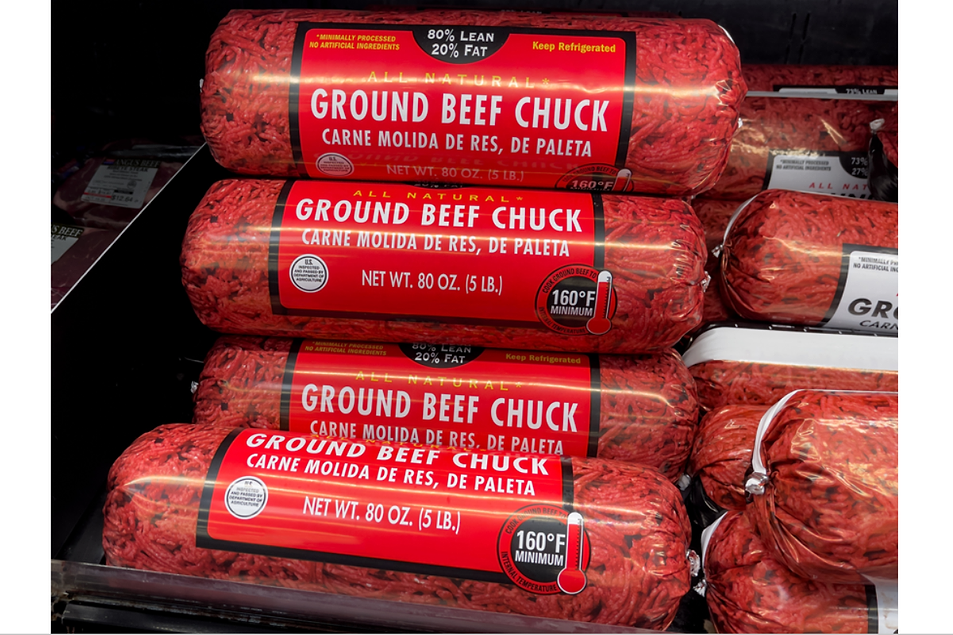
Among the more popular items in the meat department, ground meat, and specifically ground beef, maintained its status as a growth superstar, representing 85% of total grind sales. With a growth rate of 14.7%, ground beef sales in 2025 topped $17.4 billion, a $2.2 billion increase over the previous year and volume ticked up 3.6%. In general, grounds continued to astound, Roerink said. Well behind beef, turkey ranked second highest in sales, at $2.08 billion, a 6.2% increase over the prior year despite a slight drop (.04%) in volume. Ground chicken showed the biggest increase of the category, growing year-over-year by 25% in both sales ($410 million) and volume. Ground pork grew modestly in 2025 (2.4%) with sales of $231 million with volume ticking up nearly 4%. Ground lamb sales, meanwhile, topped $60 million, an increase of over 13% with volume growing by nearly 8%.
Despite the rising cost of food and beverages, shoppers are proving that meat and poultry have become a budget priority. And at the highest end of that cost is beef. Roerink pointed out that dollars spent on beef per year increasing by $94 per household as the number of trips to the store and dollars per trip spent on beef has steadily increased over the past four years. Roerink said one of the most common questions she hears is about beef and what the future holds for this category and whether it can possibly grow any more.
“I always look at different demand signals,” she said. “We see that beef has been the top growth area for several years in a row. That’s important. We see that more households are moving into beef, especially ground beef driven by Gen Z and millennials. We’re seeing more trips. We’re seeing more dollars per trip. So, I think this is a very, very positive sign that we’re going to continue to see strength for beef.”
She added that there is a notable decrease in beef category growth percentage over the past several years, which may signal a shift in types of beef purchased based on price.
“What I think we are going to see is a little bit of a recalibrating of dollars to cuts and kinds that are a little bit less expensive.”
Diet and nutrition
After presenting her in-depth overview of the latest Power of Meat study, Roerink was part of a panel of retail experts focused on providing context for the trends identified in the study and answering attendees’ questions about retail consumer trends, including diet trends and nutritional attributes of animal protein.
One topic of discussion was about the prevalence of consumers using GLP-1 drugs to help manage their weight and health issues, and how meat department operators can capitalize on this trend. Roerink said with many non-meat products highlighting protein content, promoting animal protein as the best choice is an opportunity to appeal to GLP-1 users and dieting consumers who are striving to eat smaller portions.
“I think we’re going to have a large number of people on GLP-1s, and we can pull them into the meat department because they are highly engaged with other sources of protein as well,” she said. “We need to make it easy.”
Another element of the changing meat marketing landscape discussed was how foodservice offerings, like Arby’s Steak Nuggets and Chipotle’s Chicken, signal opportunities for retailers to lure customers seeking cheaper and more varieties of protein versus QSR meals.
Claims-based meats were also discussed, including how regeneratively raised meat could bring more health-minded and bigger spenders into the meat department.
Roerink encouraged meat companies and retailers in attendance to extend their online descriptions beyond traditional product information. She encouraged them to promote attributes such as marbling, taste and quality throughout their websites.
Roerink and other panelists also discussed the importance of including diet and nutrition information in meat to boost online information used by search engines and AI, as more people use those tools to create their recipes.
“We need to lean in, and we need to do the same thing that dairy and seafood are doing,” Roerink advised. “We are healthy. We are nutritious. We are part of the diet.”
#Consumers #recalibrating #meat #purchasing #patterns
About the Author