HERSHEY, PA. — The Hershey Co. began fiscal 2026 with nearly 11% growth in first-quarter sales, boosted by last year’s LesserEvil acquisition, and adjusted earnings per share that beat Wall Street’s high-end estimate by more than a quarter.
Kirk Tanner, who became president and chief executive officer of Hershey last August, touted the robust fiscal-year start as a validation of Hershey’s aggressive growth push – including the development of more billion-dollar brands – and its new One Hershey US operating model. Launched March 16, One Hershey unifies the chocolate and snack maker’s US sweet, salty and protein businesses under a single commercial operating structure.
“We kicked off the year strong and are on track to hit our financial targets for 2026,” Tanner said when discussing the company’s first-quarter results. “We are laser-focused on fueling core growth and making bold moves in brand investment, innovation, R&D, technology and talent to drive our business to new heights. Four weeks ago, at investor day, we laid out exactly where Hershey is going and how we will get there. Q1 reflects solid progress against that plan. Our core performed well, our newer bets showed real traction, and our teams delivered at retail as One Hershey. We feel good about where we’re headed, and our full-year outlook is unchanged.”
For the quarter ended March 29, net income jumped 94% to $435.1 million, equal to $2.13 per share on the common stock, from $224.2 million, or $1.10 per share, a year earlier, when Hershey recorded $211.5 million in derivative mark-to-market losses. On an adjusted basis, net earnings climbed almost 13% to $478.9 million, or $2.35 per share, from $425.4 million, or $2.09 per share, a year ago. Analysts, on average, had forecast adjusted EPS of $2.09 at the top end.
“A strong core is our top strategic priority,” Tanner said. “We see continued consumer demand for confection, even as shoppers make more deliberate choices about their spending. Investments in media, merchandising and innovation across our iconic brands are driving growth.”
First-quarter net sales surged 10.6% to $3.1 billion from $2.81 billion a year ago. Organic net sales in constant currency rose over 7.9%, driven by net price realization of 10% that was offset by a roughly 2% dip in volume/mix. Hershey said the decreased volume reflected elasticity impacts in its North America Confectionery and International segments, while the 2025 acquisition of organic salty snacks maker LesserEvil lifted the top line by 2%.
North America Confectionery net sales advanced 8.3% year over year to $2.49 billion, with organic sales (constant currency) up 8% as 12% growth in pricing more than offset a 4% decline in volume/mix. Hershey attributed the latter to price elasticity and one fewer shipping day in the period.
“Within our North America Confectionery segment, price elasticities were comparable to what we saw in the fourth quarter of 2025 and favorable versus planned levels,” Tanner said. “This was offset by unfavorable winter weather and consumer macro pressure, which we are monitoring closely. SNAP program changes had a mild impact on our categories given the limited states where waivers have taken effect.”

Hershey’s North American Salty Snacks saw net sales jump 26% in the first quarter, as the acquired LesserEvil organic snack brand provided a 20-percentage-point lift.
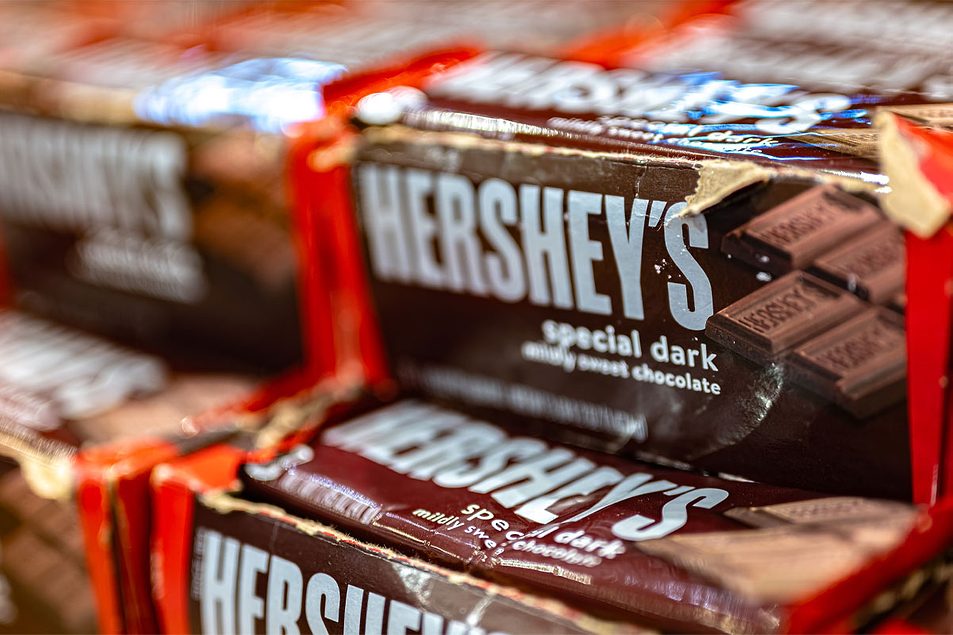
| Photo: ©JETCITYIMAGE – STOCK.ADOBE.COMNon-seasonal retail sales climbed 11% for the Hershey’s brand and 10% for Reese’s in the quarter, while Jolly Rancher generated a nearly 5% gain, outpacing the sweets category, according to Hershey.
“We’ve also seen strong demand for gum and mint products as the category benefits from functional snacking tailwinds, including GLP-1 adoption,” Tanner said. “Retail sales for our third-largest confection brand, Ice Breakers, increased over 8% in the quarter.”
The CEO noted, “Functional snacking is one of the high-growth platforms we discussed at investor day, and we are off to a solid start in 2026. Protein bar portfolio consumption increased 17% in the first quarter, ahead of the category, driven by targeted marketing and momentum in the club channel.”
Net sales for North American Salty Snacks surged 26% to $350.1 million, with the LesserEvil acquisition providing an approximately 20-percentage-point lift, Hershey said. Organic sales for the segment rose 5.6%, primarily from 5% growth in volume/mix as pricing was flat.
High trial and repeat rates and ramped-up distribution fueled 65% growth in LesserEvil retail sales, he said, adding, “We are encouraged by this early performance and focused on building on it through continued distribution expansion, adjacent category entry and brand-building investment.”
International segment net sales totaled $264.2 million, up 16.1% on a reported basis. Organic sales (constant currency) gained 9.3% on a 12% pricing increase and an approximately 2% decrease in volume.
Hershey maintained its fiscal 2026 outlook, projecting adjusted earnings per share in a range of $8.20 to $8.52 and net sales growth of 4% to 5%.
“Looking forward, we remain confident in our full-year targets for organic net sales growth of 2.5% to 3.5% and adjusted EPS growth of 30% to 35%,” Tanner said. “We are closely tracking SNAP program changes, health and wellness trends, choiceful consumer spending and broader macro pressures, including gas prices and inflation. We believe our current outlook appropriately reflects what we know today.”
#CEO #Hershey #feels #good #headed
About the Author