ANAHEIM, CALIF. — The topic of ultra-processed foods (UPFs) has evolved over the past year from a growing concern among consumers into industry action in the form of a new certification that labels certain consumer packaged goods (CPGs) Non-UPF Verified.
While there is no official definition yet for what constitutes an ultra-processed food or beverage, some groups like the Food Integrity Collective/Non-GMO Project — which created the Non-UPF Verified seal — have sought to at least narrow the parameters for what a UPF is through guidelines that limit added sugars, scrutinize the ingredients for what they consider permissible/forbidden, and define whether the processing method for those ingredients is permissible/forbidden. If a product meets those guidelines, it will earn a Non-UPF Verified seal.
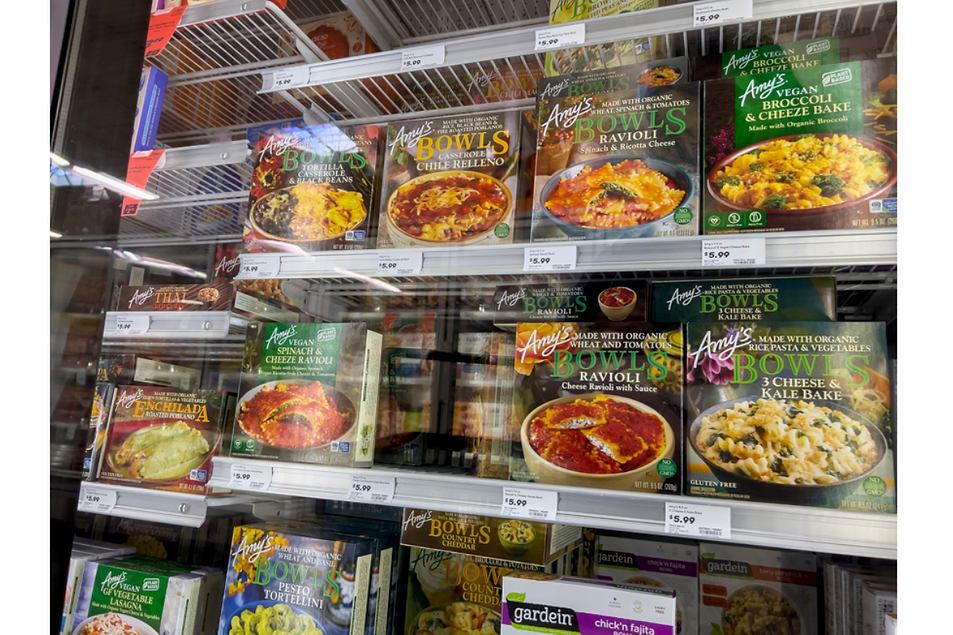
Brands like Spindrift, Simple Mills and Amy’s Kitchen are among the first companies with products certified as Non-UPF Verified by the organization. Amy’s Kitchen — which produces frozen entrees, pizzas and burritos, along with soups and salsas — currently has 37 products that are Non-UPF Verified.
During a panel discussion about UPFs at the recent Natural Products Expo West trade show in Anaheim, Paul Schiefer, president at Amy’s Kitchen, said manufacturing facilities also play a part in whether a CPG eventually leans toward having UPF or non-UPF qualities.
To illustrate his point, Schiefer detailed how Amy’s transitioned what he said was an industrial processing plant for macaroni and cheese — which Amy’s purchased from a traditional CPG company that Schiefer wouldn’t name — into a facility that produces macaroni and cheese that meets Amy’s standards.
Mac and cheese makeover
Amy’s frozen macaroni and cheese meals aren’t Non-UPF Verified yet, but they are certified organic by Quality Assurance International, and are Non-GMO Project verified by Food Integrity Collective. Schiefer said Amy’s will have another 100 products Non-UPF Verified by the end of March, which could include its macaroni and cheese entrees.
“We did buy a 500,000-square-foot frozen food plant from one of the big CPG companies,” Schiefer said. “I will say that their products will not meet (Non-UPF Verified standards). And I can tell you from their food, and also seeing how their food was made, why that’s true. When we took this plant over, they had what they called a kitchen. It was less than 20,000 square feet of space. It looked more like a pharmaceutical plant, or maybe a gasoline refinery. Imagine a lot of pipes and steam injection and silos of powders, things like that, and then outputs of sauce … would come out the other end.”
Schiefer said Amy’s expanded that kitchen space from 20,000 square feet to 60,000 square feet, and changed the facility’s flow of production from a focus on high-volume machine processing to cooking from scratch as much as possible, with more physical space needed to accommodate the additional kitchen equipment.

Amy’s Kitchen currently has 37 products that are Non-UPF Verified. The company expects another 100 of its SKUs to be Non-UPF Verified by the end of March.
| Photo: ©COLLEENMICHAELS – STOCK.ADOBE.COM“We actually had a lot of cooks (at that facility),” he said. “But they were less cooks, and more like machine operators we had hired from the prior plant into Amy’s. They described the (previous) process as taking a refined, affordable oil, adding cheese powder, milk powder, starchy powder, flavor powder and some salt. They showed us where all these little intake valves, vacuum cleaner-type things would suck the powders up, and then the sauce would come out.”
Schiefer said Amy’s replaced that system with 1,000 lb stainless steel kettles, making their sauce with organic butter and flour to start.
“We taught these cooks how to make a roux, smell it, and stir it until you get to that nice kind of walnut flavor,” he said. “We add in buckets of milk and we stir that together to make a bechamel sauce. Then we add buckets of grated cheese, and a little salt at the end. That part blew their mind.”
Schiefer told a cook during training there was one more step after making the sauce in a kettle.
“We gave him a spoon,” Schiefer said. “He said, ‘What’s this for?’ We told him it’s to taste the sauce. He said, ‘I’ve worked at this plant for 14 years and I never once tasted the sauce.’ Part of me laughs, but part of me is quite sad that this is actually what most of the conventional food system has developed as a way to feed people.”
Schiefer added that the current scramble from CPG companies to reformulate their products in response to consumer pressure and government plans to phase out artificial colors and flavors should have brands rethinking not just what goes into their products, but the step-by-step methods in which they’re made.
“I really hope that this industry doesn’t just say, ‘How do we reformulate?’, but recognizes that this is a real opportunity to continue to differentiate and improve the food system,” Schiefer said. “If your business model can’t do it, change it. It can (change), and if it does, kudos to you, and hopefully this (Non-UPF Verified seal) helps us get that message out in a better way.”
#shift #scratch #cooking #reduce #UPFs
About the Author