NEW YORK – Consumers are increasingly seeking different beverages for different purposes, and the trend is spurring investment in drinks formulated for hydration, energy and/or nutrition starting in the morning and extending throughout the day.
The all-day consumption is called the “afternoon economy” by Verlinvest, a global consumer investment firm with ownership shares in Oatly, Vita Coco and other beverage and food companies.
“People now consume beverages not just for enjoyment or for pairing with a meal or waking up in the morning, but also they can see that beverages apply to a lot of occasions,” said Lindsay Haut, senior principal at Verlinvest’s US headquarters in New York City.
As hydration spans day parts from morning to evening in a variety of formats, she said it incorporates the consumption of caffeine but in an evolving way.
“Caffeine is changing a bit — initial morning but then transitioning to another trend in the afternoon and in the evening,” Haut said.
For younger consumers, she said it may mean choosing matcha or another drink that looks and tastes good and provides a steadier, calmer alternative to coffee or another more heavily caffeinated beverage.
Illustrating the range of today’s options are the better-for-you beverages meant to support active lifestyles and, for those looking for more of a boost, the energy drinks that are still one of the fastest-growing categories out there, Haut said.
“Look at trends like Celsius or Alani Nu and brands that are specifically targeting women,” she said. “On the one hand, you have let’s caffeinate gently and use it as a little treat, and then you have the drinks that are more caffeine and let’s get that energy boost.”
Hydration innovation
Consumers generally have become more aware of the importance of hydration and are trying to regularly get the fluids and nutrients they need, Haut said. She called hydration “a tangible benefit that you can feel” and one that has people consuming regular water up through all the different beverage categories that have launched in recent years.
Some large consumer packaged goods (CPG) companies have innovated in the beverage sector by targeting products at consumers looking for more functional hydration.
The Kraft Heinz Co. recently introduced a functional version of Capri Sun for kids called Capri Sun Hydrate with electrolytes and 50% less sugar. Tropicana Brands is producing Tropicana Hydrate with electrolytes and coconut water, and Campbell’s recently launched V8 Energy with Electrolytes in yuzu lemon flavor for a limited time.

Large CPG companies like Tropicana, The Kraft Heinz Co. and Campbell’s Co. have introduced beverages focused on hydration.
| Photo: Tropicana Brands GroupWhether the well-known brands will be able to pull people in with add-on ingredients remains to be seen, but Haut said their appearance in the market indicates how much beverage innovation is catching on.
“These really big companies moving in that direction shows that people who are shaping this industry are thinking,” she said, adding, “I think the trend will be here to stay, but there are multiple ways to win in this category.”
The lure of hydration powder
One way some consumers are hydrating is by adding to water or another liquid specially formulated hydration powders containing electrolytes like sodium, potassium and magnesium.
“The hydration powder category is really big now,” Haut said. “I think it’s an interesting format because it can be used in multiple ways. There’s convenience in a format that’s already mixed, but then there’s the one you mix on your own.”
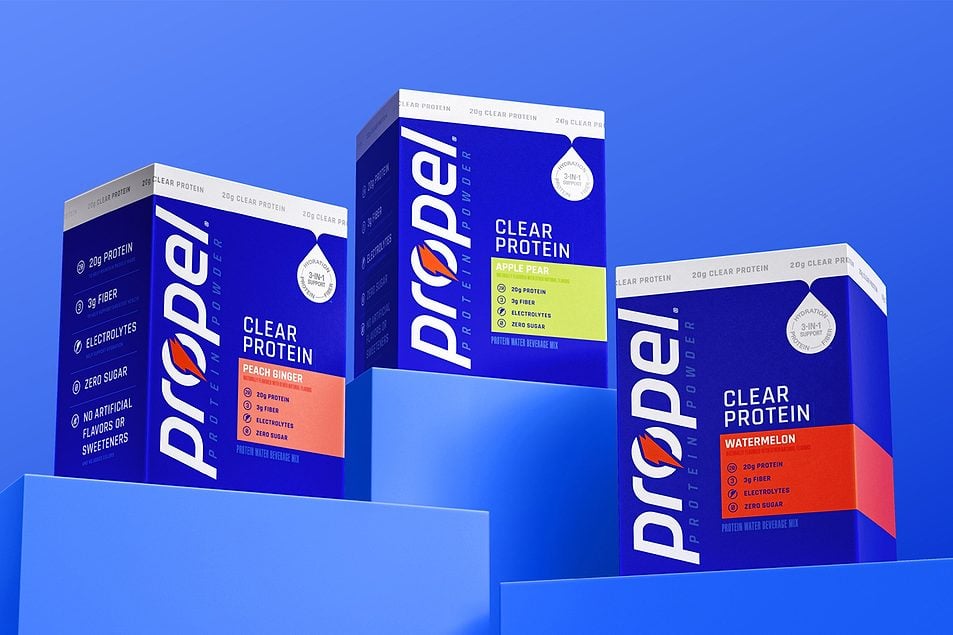
PepsiCo, Inc. recently extended its Propel brand with a beverage powder formulated with electrolytes, protein and fiber. Unilever and The Coca-Cola Co. also have introduced branded hydration powder products.
Verlinvest, which is headquartered in Belgium, watches beverage and other trends in the US to see if they’re taking hold in Europe, Haut said. Hydration is one example.
The company’s venture firm, V3 Ventures, has participated in a funding round for Holy, a powder-based soft drink brand founded in Germany, which is marketed as a healthier alternative to traditional sodas.
“We’re always looking at investing in other beverage categories, and I think that’s true in every region, and it’s probably a little bit different in each,” she said.
Oatly and Vita Coco are just two of Verlinvest’s beverage investments, although it has also backed companies producing water, soda, wine, coffee and spirits. Oatly produces plant-based beverages in a variety of formats, while Vita Coco produces coconut water and other coconut-based drinks.
Sweden-based Oatly has reported increasing retail sales in North America this year, while net sales of New York-based Vita Coco Coconut Water jumped 42% during the first quarter compared with the year-ago period.
As consumers seek hydration, energy and other functional purposes from beverages, Haut said the products likely to win in the sector will be the ones that make people feel good and taste good.
“…(W)e talk about functionality and what a product is supposed to do, but the first determination a consumer makes is on taste,” she said. “We talk about layering all these other functions, and sometimes we can lose sight of that.”
#Beverage #makers #battling #win #afternoon #occasion
About the Author