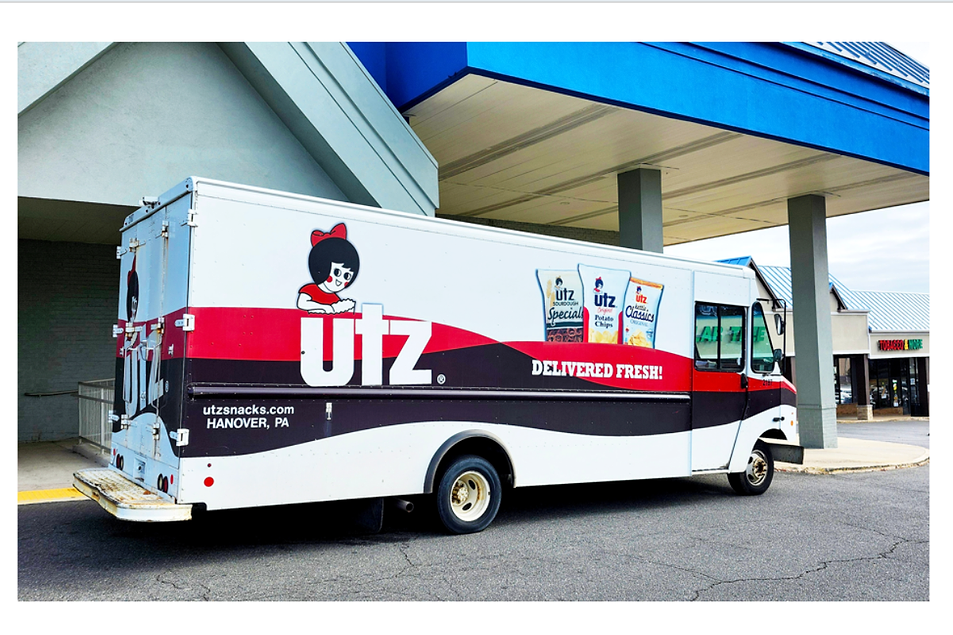
HANOVER, PA. — Utz Brands Inc. benefited from strength in branded salty snacks and advanced its strategic priorities in the fiscal 2026 first quarter, despite posting its third straight quarterly loss.
“Our first-quarter performance underscores our commitment to delivering on our key strategies,” said Howard Friedman, chief executive officer. “First, outgrow the category, profitably driven by our Power Four brands and geographic expansion. Second, drive margin expansion through productivity and reinvest strategically in marketing and growth. Third, accelerate free cash-flow conversion. All of these outcomes are made possible by our capabilities and associates, and I am proud of our progress.”
For the quarter ended March 29, Hanover-based Utz had a loss of $2.4 million, compared with year-ago net income of $5.7 million, equal to 9¢ per share on the common stock. That followed losses of $3.3 million in the fourth quarter and $20.2 million in the third quarter of fiscal 2025.
Utz noted bottom-line impacts from increased depreciation and amortization during the quarter, as well as a prior-year $11 million gain from the remeasurement of warrant liability. Adjusted net earnings were $21.3 million, or 15¢ per share, down from $22.3 million, or 16¢ per share, a year earlier. The result was in line with Wall Street’s high estimate for adjusted earnings per share of 15¢.
“We delivered strong margin performance with adjusted EBITDA up 6.2% and adjusted gross profit margin expansion of 210 basis points,” said William Kelley, chief financial officer. “Our productivity initiatives drove these gains, allowing us to offset supply chain cost inflation and fund our continued marketing and SG&A investments.”
Adjusted EBITDA margin grew 50 basis points to 13.3%, aided by productivity savings, volume/mix and pricing but partially offset by increased supply chain costs and inflation, higher marketing spend and SG&A, with the latter rising over 13% in the quarter.
“This increase was largely driven by planned investments in marketing, selling and capabilities,” Kelley said. “Note that our planned investments in California expansion are present in both supply chain costs and SG&A, and the phasing is as expected.”
Net sales in the first quarter rose 2.6% to $361.3 million from $352.1 million a year ago. Organic net sales also grew 2.6%, as a 3.7% rise in pricing was partially offset by a 1.1% decrease in volume/mix. Utz said the year-ago Bonus Packs promotion had a net-neutral 2.7-point impact on volume/mix and price but, excluding that promotion, volume/mix gained 1.6% and pricing rose 1%.
Utz’s branded salty snacks business saw sales rise 5% — driven by Power Four Brands Utz, On The Border, Zapp’s and Boulder Canyon — on increases of 1.1% in volume/mix and 4.1% in price. Meanwhile, sales for non-branded/non-salty snacks (11% of net sales) dropped 14% as volume/mix sank 15% and pricing inched up 0.8%.
“Our top-line performance was solid this quarter,” Friedman said, pointing to both net and organic sales growth. “We were encouraged to see the improvement in both metrics versus the fourth quarter of 2025. Retail inventory levels have largely normalized, and our branded salty snacks organic net sales growth of 5.2% was modestly ahead of first-quarter retail sales growth of 4.6%. The category continues to show signs of improvement, with first-quarter retail sales growth of 2.4%. We gained dollar share in the category, despite the volume share impacts from lapping Bonus Packs in the first quarter of last year.”

At Natural Products Expo West, Utz Brands showcased its Boulder Canyon flavored tortilla chips and debuted Utz Protein Pretzels and Cheese Curls, among other items.
| Photo: Utz BrandsBranded salty snacks now account for 89% of Utz’s net sales, compared with 11% for non-branded/non-salty snacks.
“Since the first quarter of 2023, branded salty snacks mix has increased by 10 percentage points from 79% of our net sales to 89%,” Friedman said. “We continue to emphasize our branded salty snacks portfolio, which is higher-margin and higher-visibility and benefits from our marketing and innovation plans.”
The slack performance by non-branded/non-salty snacks stemmed mainly from declines in partner brands, he said.
“We further accelerated plans to eliminate lower-margin items in this portfolio,” he said, noting that portfolio rationalization had a 230-basis-point impact on the segment’s sales and a 60-basis-point impact on total sales in the quarter. “We believe emphasizing our own portfolio of branded products is the right long-term business strategy.”
Retail dollar sales in Utz’s core geographies rose 2.7% year over year, compared with a nearly 7% gain in expansion geographies.
“We believe the growth runway remains substantial, as our average market share of 3.1% in our expansion geographies versus 6.6% in our core markets illustrates the opportunity we see ahead,” Friedman said, noting growth in California. “Our California expansion initiative launched in late February, and we will continue to build new distribution in the market as we progress through 2026. California exhibited high-single-digit, year-over-year retail sales growth in the first quarter.”
The Boulder Canyon chip brand headlined Utz’s innovation efforts, with the launches of Boulder Canyon Beef Tallow potato chips and Boulder Canyon Flavored tortilla chips exceeding expectations, Friedman said. Utz plans expanded rollouts for both products later this year, as well as for a newly launched item from the Utz brand.
“We are excited to launch Utz Protein in the second quarter, with four pretzel SKUs and two cheese SKUs,” he said. “This product is currently in market at select retailers, with plans to roll out more fully by the end of the second quarter.”
Utz upheld its full-year outlook for a 3% to 6% decline in adjusted EPS, adjusted EBITDA growth of 5% to 8%, and organic net sales growth of 2% to 3%.
#Utz #Brands #salty #Food #Business #News
About the Author