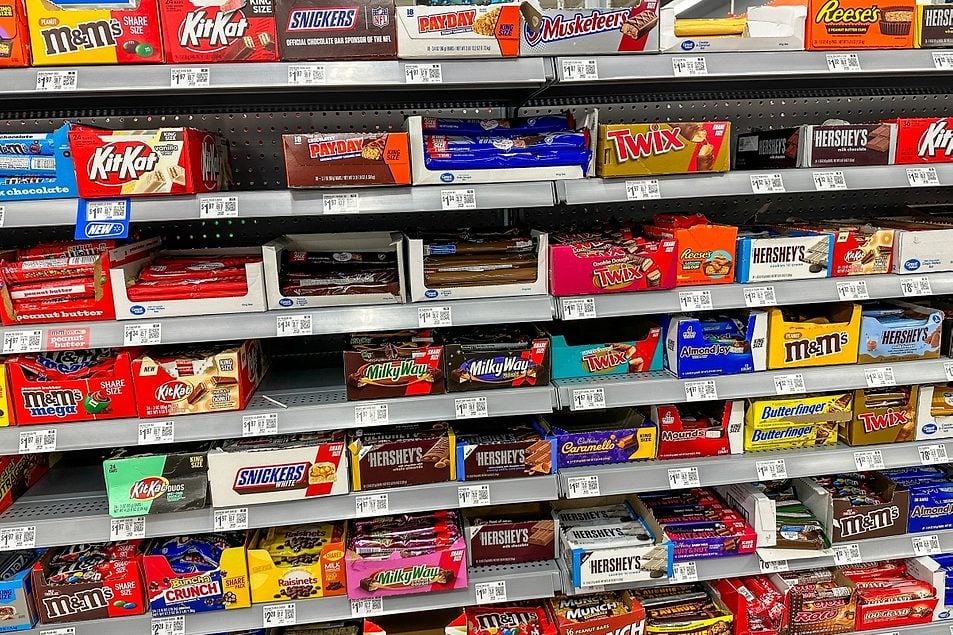
The Food and Drug Administration’s proposed front of package labeling regulation looms over the confectionery category, giving some companies reasons to reformulate products to make them more appealing to consumers.
The FDA, in the Federal Register issue of Jan. 16, 2025, proposed nutrition information boxes on the front of packages that indicate saturated fat, sodium and added sugars content. The information would rate the products low for 5% or less of the Daily Value, medium for 6% to 19%, and high for 20% or more. The FDA gave an example of cookies rated high in saturated fat, low in sodium and medium in added sugar.
“You don’t game the box,” said Thom King, chief innovations officer at Icon Foods, Portland, Ore. “You engineer the system behind it. Front-of-pack is going to compress the story into a few brutal numbers: added sugar, saturated fat, sodium. That means formulators need to stop thinking in terms of ingredient swaps and start thinking in terms of macro architecture.”
Products may be reformulated to avoid the “high” designations for sugar, saturated fat or sodium on the front-of-pack label, said Heidi Geisenhoff, senior product manager, dairy nutrition at Glanbia, based in Chicago.
“This may allow for a shift from a ‘high’ designation to a ‘medium’ or ‘low’ on the front label,” she said. “Portion size is another tool. Offering smaller servings or individual packs sizes will lower the percent Daily Value per serving of sugar, saturated fat and sodium displayed on the front label. If calories per serving are reasonable, companies may choose to add this to the front-of-pack nutrition boxes. This is not mandatory but could be another way to highlight a ‘better-for-you’ positioning.”
Sweeteners and fibers both may lower sugar levels. In candy and chocolate, some of the sugar may be swapped for prebiotic fiber, keeping the same sweetness and bulk with less added sugar on the label, said Hannah Ackermann, vice president at Comet, Schaumburg, Ill.
“For sugar, pair high-potency sweeteners or flavor modulators with prebiotic fibers like Arrabina (arabinoxylan fiber) so you keep bulk and mouthfeel while slowly walking added sugars down,” she said. “In chocolate and chewy formats, Arrabina’s sweetness and bulk allow part of the sucrose or syrup to be replaced, which cuts added sugar and energy density and can support lower saturated fat recipes by maintaining mouthfeel when fat is reduced slightly.”
Polyols are another option. Isomalt, a polyol, is made from beet sugar and has 2 calories per gram, which compares to sugar at 4 calories per gram, said Kyle Krause, regional product manager, functional fibers and carbohydrates, North America for Beneo and based in Morristown, NJ.
“It has a negligible effect on blood sugar,” he said. “With a rounded sweetness profile similar to sucrose, Isomalt works great in a broad range of confectionery applications and beyond. As a bulk sweetener, Isomalt mimics the texturizing role of sugar in biscuits, for example, and has a pleasant sweetness on top.”
Inulin-type fructans provide fiber and reduce sugar.
“Although not a sweetening ingredient as such, they provide an excellent choice for reducing sugar in a wide array of baked goods,” Krause said. “They have a naturally sweet taste and additionally deliver improved body and mouthfeel.
“Additionally, the prebiotic fibers are non-GMO, low-calorie and low-glycemic ingredients. While the natural sweetness allows food manufacturers to keep added sugar to a minimum, still offering excellent flavor, its nutritional fiber enrichment and prebiotic effect are additional benefits, allowing for claims regarding digestive health.”
Protein fortification has been shown to help rebalance perception and improve satiety, allowing for lower overall sugar levels, said Martin Schweizer, PhD, vice president of technical development for Burcon NutraScience Corp., Vancouver, BC.
Ingredient blends work as well.

In chocolate, saturated fat from cocoa butter is critical to hardness, snap and melt quality.
| Photo: ©AFRICA STUDIO – STOCK.ADOBE.COM“Sugar reduction is the easy part,” King said. “Replacing what sugar does is the hard part. Added sugars come down with systems: allulose for bulk and browning, polyols for structure and humectancy, stevia and monk fruit for top-note sweetness, and modulators like thaumatin to clean up the edges.”
Alternative sweeteners such as polyols or allulose may help lower sugar values on the package, said Hannah Scolaro, senior technical services specialist for Minneapolis-based Cargill.
“But they often impact texture or flavor with a one-to-one swap, resulting in a firmer or crunchier product and potential cooling effect in the aftertaste,” she said. “Success typically comes from using optimized blends and combinations with fibers and understanding how each component contributes to the final structure.
“Ultimately, improving front-of-pack nutrition in confectionery is less about substitution and more about rebuilding the system, while maintaining the sense of indulgence that draws consumers to the category in the first place.”
Inulin may replace fat in products due to its long-chain molecular structure and its low solubility, which allows it to form fat-like granules in water-containing systems under high sheer, Krause said.
“With its neutral and balanced flavor, it does not affect the taste of the product, yet delivers in terms of a similar mouthfeel, texture and creaminess,” he said. “In addition, the fiber benefits of adding inulin to products enable a ‘fat out, fiber in’ message to be communicated to consumers.”
Rice starch has been shown to reduce fat in products and still convey a creamy texture and mouthfeel, he said.
“Rice starch obtains textures ranging from short to long, making it ideal for use as a fat replacer,” Krause said. “Rice starch is also suitable for fat reduction in water-based (dairy) and fat-based (confectionery and bakery fillings) systems.”
In chocolate, saturated fat from cocoa butter is critical to hardness, snap and melt quality, Scolaro said.
“The industry is actively working to develop tailored systems of fats, sugars and starches that more closely replicate those sensory cues — but it’s still a work in progress,” she said
Schweizer said plant proteins have been shown to help reduce reliance on animal-derived ingredients such as eggs and certain dairy components. The reduction allows product reformulation to shift toward lower fat and more plant-forward formulations while maintaining structure and texture.
King added that reductions in saturated fat may be achieved through cocoa butter equivalents, fractionation and using fibers or hydrocolloids to carry texture instead of fat load.
Sodium may be reduced in coatings, inclusions and flavor systems, King said.
“You manage it through better flavor design, not just removal,” he said. “If you’re pulling three levers at once — fat, sugar and sodium — you need a systems approach or the product falls apart.”
Reformulating confectionery items is not as simple as swapping out the fat, lowering the sugar content or switching out the sweetener, Scolaro said.
“In confectionery, those components are fundamental to taste, texture, structure and eating quality,” she said. “In an indulgent category like confectionery, there’s little margin for error. If you don’t deliver, consumers won’t come back.”
#Putting #nutrition #front #confections
About the Author