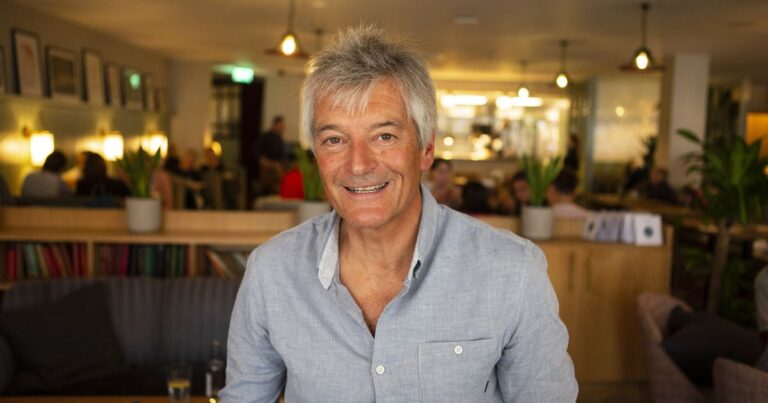
Professor Mark Barry of Cardiff University who created the vision for the South Wales Metro gives his verdict of the UK Government’s committed over the long-term to invest in rail enhancement projects across Wales

Keir Starmer making a commitment to invest in the Welsh rail network for the long-term at TfW’s Taff’s Well depot.(Image: Getty Images)
Last week Prime Minister Keir Starmer acknowledged the need for more UK Government investment in Wales’ non-devolved rail network and committed to fiscally support the programme over the long-term.
He endorsed a vision set out by Transport for Wales (TfW), which implies capital funding across Wales over at least 15 years running into billions – the headline is £14n into the 2040s. In the short-term this includes restated commitment to upgrade the South Wales Mainline, the Burns stations and services, funding to support Cardiff Parkway and interventions in North Wales – including a new Deeside Industrial Estate station.
Whilst there appears to be no further funding in the current £300m spending review period to March 2030, this is still a political endorsement from the Prime Minister to a rail investment programme in Wales of around £1bn per year post the next spending review period.
READ MORE: Data centre and renewable investment plans at Global Centre of Rail Excellence site delayedREAD MORE: Seven new train stations for Wales as UK Government commits millions for rail
However, more pressing is the early need to bolster the current £300m commitment to fully fund the initial schemes set out by the Prime Minister and First Minster Eluned Morgan and to reflect the reality that the schemes in the spending review, and restated, have a price tag of probably £600m to £700m These are:
- South Wale Mainline relief line upgrade:
- Six Burns stations now including Parkway and additional rolling stock for the additional Cardiff-Bristol services:
- Metro Central (£140m upgrade of Cardiff Central Station);
- Cardiff West (junction upgrade);
- Padeswood sidings;
- North Wales Mainline level crossings; and
- Deeside Industrial Estate Station.
The UK Government could also have acknowledged that Welsh Government have funded most of South Wales projects from its block grant (so impacting spending in areas like health and education, and offered to increase its contribution so that further schemes could be initiated now.
For example, the electrification to Penarth and a passing loop on the Coryton line as part of Cardiff Crossrail phase two to enable four an hour tram-train an hour through Penarth-Bay-Coryton services. This will free up Stadler built trimodes for the new Cardiff-Bristol Burns” services. The UK Government should also have offered a more reasonable ongoing settlement to cover the overall maintenances and repair costs for the Core Valley Lines (the only devolved part of the rail network in Wales. We could also have seen further funding to accelerate development of the Metro in Swansea.
Nonetheless, this new political commitment is clearly a positive step in the right direction toward the full devolution of rail powers and funding, which is what Wales needs. Not least because, full devolution and a fair, commensurate block grant adjustment, locks these commitments in place and avoids the risk of new ministers and/or governments at Westminster “changing their mind”. I also think, in advance of a fully devolved settlement, this Wales rail enhancement pipeline needs its own Department for Transport budget line.
Overall, I accept this announcement as a positive step forward toward the ultimate goal of a fully devolved rail network in Wales. I have no doubt the efforts of the First Minister, Jo Stevens (Welsh Secretary) , Ken Skate (Transport Secretary) as well as Peter Hendy (UK Rail Minister), were instrumental in raising the profile of Wales’s rail investment needs at Westminster to secure these political commitments. So, credit where credit is due
The TfW vision document, Today, Tomorrow, Together, is a pretty impressive list of possible rail investments in the Wales and Borders route over the next 15-20 years and reflects a significant effort over the last five years by TfW (some of which I helped initiate) and the support of Welsh Government.
This effort has also precipitated a close and effective working relationship with Network Rail’s (NR) strategic planning team in Wales, key local authority and regional partners and Department of Transport (DfT) Officials.
The collective capability and capacity led by TfW to undertake and lead such work is now far beyond what the UK Government’s Department for Transport (DfT) and NR were historically able to achieve in respect of rail enhancements in Wales.
The level of ambition for Wales’s rail network is clear; this is something that was missing for decades but addressed in the period following the publication of my case for investment for Minister Ken Skates in 2018.
It begs the question, why until TfW was established, did the DfT or NR (who have been, and are still, apart from the Core Valley Lines (CVL), custodians of our non-devolved railway not bring forward such ambitious proposals in the previous twenty years?

(Image: PA)
The answer is that we have a very London/England centric Whitehall bureaucracy that impacts not just Wales and Scotland, but much of England as well.
So enormous credit to TfW in bringing this strategic development work to a wider audience. It pretty much aligns with my summary of future rail investment plans for Wales published in my book in 2024.
It includes the expansion of the South Wales Metro (especially in Cardiff via Crossrail, and capacity improvements on the Maesteg and Ebbw Valley lines), Network North Wales, the initial phases of a Swansea Metro and the upgrade of the South Wales Mainline, the North Wales Mainline and Marches Line.
The glaring Metro omission in the current programme are in Cardiff – the requirements for a minimum of four trains per hour Metro services on the City and Coryton Lines which are long standing. While the omission is thankfully reflected in the prospectus, it needs to be the priority for the next stage of Metro development, as “fixing” Cardiff will drive the most additional passengers for the fewest track kilometres of any schemes in Wales, so it makes financial sense as well.
Furthermore, Cardiff Crossrail phase two is entirely absent as a coherent programme. Yes, its component parts are in there but are fragmented in presentation and development. This is despite the fact that TfW are working on the business case with Cardiff Council.
This Crossrail phase two programme omission is even more surprising given the total benefits are greater than the sum of the parts.
For example, from earlier draft work I was involved with, phase two has the potential to secure between 1.5 million to two million additional passengers a year to the Core Valley Lines – which currently handles circa around 12 million per year. The full Cardiff Crossrail (so east to Tremorfa/Newport Rd, Radyr-Coryton circle connection and the north west corridor to Rhondda Cynon Taf) could add a further five million. These are very significant numbers, by far the biggest of any scheme in Wales, and will have a big impact on delivering our 2040 net zero Wales public transport mode share targets.
Furthermore, the economic impact of the full Cardiff Crossrail was also estimated to add a further £900m to the economy given it helps bring forward development and regeneration opportunities across the network. This is in addition to the base £700 economic benefits calculated for South East Wales Metro and set out in the TfWs prospectus.
As relevant, the full Crossrail will serve parts of Cardiff’s southern arc that have significant socio-economic challenges. In fact, despite some assertions to the contrary, there are more people in Cardiff living in communities in the top 10% of the Welsh index of multiple deprivation than any other local authority in Wales (about 20% of the Welsh total).
To deliver Cardiff Crossrail phase two, which I estimate is a circa £200m programme, requires:
- Four trains per hour on the City Line (enabled by the commitment to upgrade Cardiff West junction):
- Four on the Coryton Line which needs a passing loop and further rolling stock:
- Electrification to Penarth and operation of tram-trains for Penarth-Coryton services, and backfilling of two trains per hour from Caerphilly with tram-trains to Cardiff Bay:
- The Penarth trimodes can be used for the new Burns services – this is the most cost-effective rolling stock solution for the new Burns Cardiff-Bristol services. This also demonstrates a very strong interdependence between the Burns programme and Cardiff Crossrail phase two where the total benefits are greater than the sum of the parts;
- Station Link – this is a network keystone and provides a short connection from the new Crossrail platforms at Cardiff Central to the existing lines to the west to allow Penarth/Coryton tram-train services to operate via the bay and Crossrail Phase 1a;
- New stations at Gabalfa, Ely Mill ad Roath Park and an additional platform at Cogan for Penarth services;
- Reversing of some CVL transformation value engineering;
- Revised and simplified service patterns;
- Lloyd George Avenue landscaping and urban realm; and
Ideally, will also include Crossrail Phase 1b to Pierhead Street.
In particular, Station Link is not, as TfW set out, a long-term aspiration as part of north west corridor– it is a fundamental and urgent need for Cardiff and the Core Valley Line network. It will:
Help address fundamental Core Valley Line network capacity, redundancy and resilience issues – this will benefit the entire CVL Metro network:
Provide the necessary capacity and redundancy for Core Valley Line services whilst Intersection Bridge is being renewed (this bridge takes the Core Valley Lines south of Queen Street over the South Wales Mainline, to the bay and Central); it had issues in 2024 which pretty much closed down Core Valley Lines services, and which will need urgent attention in the near future:;
By allowing some Core Valley Line/Penarth services to route via the new Crossrail platforms it frees up platform capacity at Central that, subject to a little further track work, makes possible more room for additional South Wales Mainline services; and
Offer more legible Core Valley Line Metro service patterns.
This work needs wrapping up into a single Cardiff Crossrail phase two programme, combined with the committed South Wales Mainline work.
Also important, but not, unsurprisingly, overtly mentioned in the rail prospectus is the role of buses and integration. In urban areas, we are trying to develop integrated multi-modal networks of rail, light rail, bus and active travel.
On high demand Metro corridors the rail services (which can carry the most people per vehicle) are the arteries and the local feeder bus services the capillaries. In the next five years the implementation of bus reform and re-designed bus networks will be equally as important as rail investment to deliver the public a single public transport network, as will the need to secure more bus revenue support.
Whilst the UK Government have now recognised the scale of investment needed and justified in Wales. We are still a long way from the “right” constitutional settlement.
In England the GB Railways Bill will deliver the badly needed vertical integration of track and train. But not in Wales. Why not? Are Whitehall officials even aware of the oversight and its implications in Wales?
The operational working relationship between TfW and NR in Wales is probably far ahead of any other NR route/region and their local Transport Authority and/or DfT. However, the current GB Rail bill risks dragging the NR Wales Route back into a hugely centralised bureaucratic organisation setting back Wales and its rail network years.
This provides further evidence that the current constitutional arrangement for rail in Wales (being non-devolved) are not fit for purpose – and the vertical alignment in Wales should focus on that between TfW and NR in Wales and less so GB Railways. I made this point in my evidence to the Westminster Transport Committee’s review of the current draft GB Railways Bill.
To be clear, despite these new announcements, to build on and enhance what has already been delivered in Wales (despite the obvious constitutional constraints), to ensure systemic fair funding and to empower Welsh Government and TfW to drive forward integrated transport policy, we need to fully devolve rail to Welsh Government and make the appropriate block grant adjustment (that also reflects its scale and relatively more depreciated state versus the rest of the UK rail network).
That will also return the Barnett Wales/DfT comparability factor to a healthy circa 95% (currently just 33.5%) ensuring much more equitable Barnett treatment in future.
Prof Barry’s article in full
#verdict #promise #14bn #rail #investment #Wales #longterm
About the Author