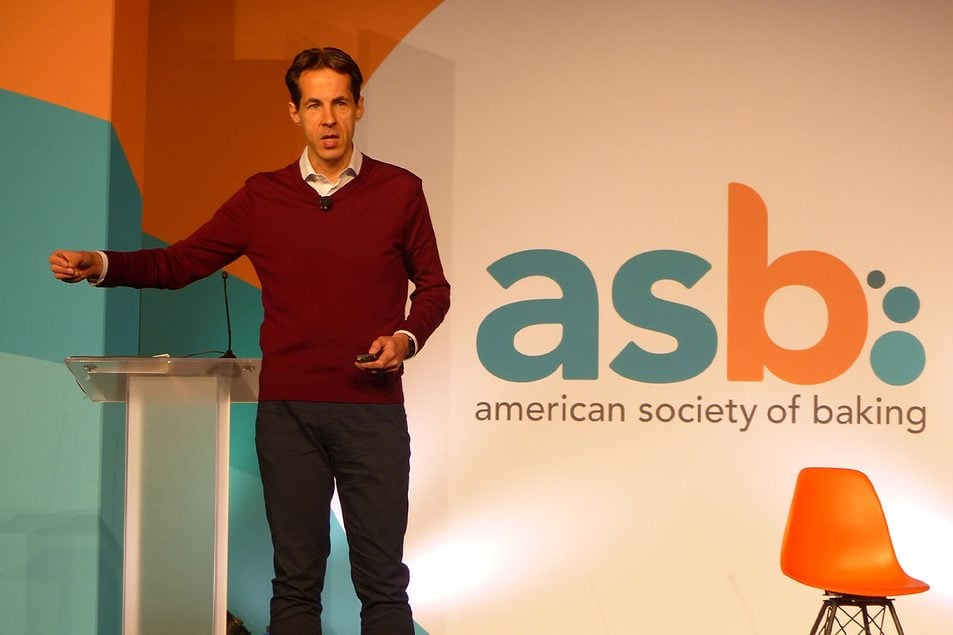
CHICAGO — No one really knows what “ultra-processed food” means, but several schools of thought among consumers warrant the attention of grain and baked foods companies, food and consumer strategist Kevin Ryan said at the American Society of Baking (ASB) BakingTech 2026 conference in Chicago.
“People have absolutely no idea what ‘ultra-processed’ means,” Ryan, founder and chief executive officer of Malachite Strategy and Research, Fort Collins, Colo., said Feb. 19 in a presentation on UPFs at the annual conference. “I have no idea, absolutely not. Maybe you don’t know what ultra-processed is.”
The Nova classification system, a widely cited method for defining UPFs, doesn’t shed any light on the meaning of ultra-processed either, Ryan noted. Essentially, the Nova system classifies food products in four groups: unprocessed or minimally processed, processed culinary ingredients, processed foods (products including the first two groups) and ultra-processed foods (industrially produced products with five or more ingredients, which may include additives and artificial ingredients not typically found in home cooking).
“This is extremely confusing,” Ryan said. “Most people have absolutely no idea. Even the researchers don’t know this. I have read many papers on ultra-processed food, and people don’t know what to put in every category.”
For example, under Nova, artisan bread would fall into the third category of processed food, and honey could fit into all four categories – including the ultra-processed group, but with bees doing the processing, he explained.
“It’s not a great system,” Ryan said. “And I would say you shouldn’t pay attention to it unless it gets regulated exactly like this, then you probably do have to worry about it.”
More important is what ultra-processed means in the eyes of consumers, because “that’s what’s going to end up being the real issue, not the noble classification,” he said.
Among consumers, there are basically “four camps of thinking when it comes to processing and ultra-processing that we need to pay attention to,” Ryan said:
• Unbothered Hedonists: These consumers have no qualms about the processing of food, as long as it tastes good. “They eat food, they like it, they don’t want to hear about it,” Ryan said.
• Vibe Validators: For manufacturers, this group raises concern because they have issues with food processing, though not necessarily based on facts. “These are folks that are basically using the term ultra-processed to mean anything that they think is unhealthy – it is the new word for junk food,” Ryan said. “What’s interesting is they will tell you that potato chips are ultra-processed, and then they will say protein bars are not.”
• Kitchen Chemists: This longtime food shopper archetype is on the lookout for long ingredient names and lists on product labels. “You’ve seen these people – ‘I can’t read the ingredient. There are too many syllables. It must be over-processed, right?’” Ryan said. “So these are folks that it’s more of a vocabulary test than anything else.”
 Photo: ©ROBERT WILSON – STOCK.ADOBE.COM
• Information Seekers: A new group, these consumers see “ultra-processed” as an alteration of a whole food’s “structural integrity,” a change in physics rather than chemistry, and “the sentiment is moving this way,” according to Ryan. “The mindset is, ‘Did you disrupt the structure? I don’t want you disrupting the structure. I trusted that.’ It is not as much about the chemistry anymore. Consumers are realizing you can’t add your way back to whole.”
Instead of processed versus unprocessed, consumers are refocusing on the perceived intent behind food processing, Ryan said. They don’t want “exploitive processing” done for the manufacturer’s benefit by “forcing palatability” or “cheating the margins,” he explained, citing examples such as extruding, isolating, bleaching or puffing. But consumers do accept “justified processing” to make food safer or more edible, such as through fermenting, cold-pressing or slow-baking.
“‘Ultra-processed’ food speaks to this worry among consumers that the processing is done not for their benefit; it’s done for manufacturing benefit,” Ryan said. “And they don’t like that. They feel that they’re not going to win in that equation.”
The baking industry can “win this conversation” over UPFs because “baking is the original good processing,” Ryan said, recommending that companies take a more proactive approach that better aligns with their customer base. Strategies to “tell the right story,” he said, include the following:
• Market Time: Time equates to digestibility, so why not highlight that by treating time as an ingredient? Instead of spotlighting “20g of protein” (chemistry) on a product package, point out qualities like “48-hour ferment” or a “12-hour sponge and dough method” (physics).
• Kitchen Logic: Terms like “emulsifying” and “pre-gelatinizing” sound like exploitive processing to force palatability. A term like “overnight oats” on a package signals justified processing and removes the industrial connotation.
• Operationalize Imperfection: Instill controlled variance, for example, by not having every cracker turn out exactly the same, the hallmark of industrial baking. Ryan noted that artisan baking incorporates variance such as char, bubble structure and shape.
• Chain of Custody: Bring a product’s identity to life by naming the variety, the farmer or where it was produced. So not just “wheat,” but “Turkey Red winter wheat.”
• “Retained” Narrative: Highlight that products “retained” certain nutrients or ingredients instead of saying they’re “enriched” or “fortified,” which signals that something was taken out and then put back in.
“Don’t talk about enriching as much as you’re talking about retaining – we retained it, we kept it,” Ryan said. “‘Fortify’ sounds like a lab experiment, whereas ‘retained’ or some other language around that makes more sense. So, market that absence of the removal and I think it’s a better message for consumers.”
#define #ultraprocessed #foods
About the Author