ST. LOUIS — Executives at Post Holdings Inc. cited some positive signs for the cereal category as the food company started off fiscal 2026 with solid first-quarter results.
Net income for the first quarter ended Dec. 31, 2025, dropped 15% to $96.8 million, equal to $1.71 per share of common stock, from $113.3 million, or $1.78 per share, a year earlier. The decrease stemmed primarily from restructuring, facility closure, integration and asset disposal costs and payment of debt premiums, according to St. Louis-based Post.
However, adjusted net earnings rose 11% year over year to $123.7 million, or $2.13 per share, from $111.9 million, or $1.73 per share. That topped analysts’ high-end projection for adjusted EPS of $1.79.
In fiscal 2025, Post completed its acquisition of 8th Avenue Food & Provisions Inc. and later sold 8th Avenue’s pasta business to Richardson (US) Holdings Ltd. Also during the year, Post finalized its purchase of Potato Products of Idaho LLC (PPI).
“Our strong first-quarter performance was driven by Foodservice (business unit); however, the overall portfolio performed quite well,” Post said. “Although retail volumes remained under pressure in Q1, we saw encouraging improvement in consumption for both the North American and UK cereal categories. Meanwhile, we remain focused on making profitable investments behind our brands and executing on cost-out to protect our margins.”
First-quarter net sales jumped 10% to $2.17 billion from $2.01 billion a year ago, partly due to the addition of $224.6 million in net sales from acquisitions, Post said.
Improved outlook for cereal?
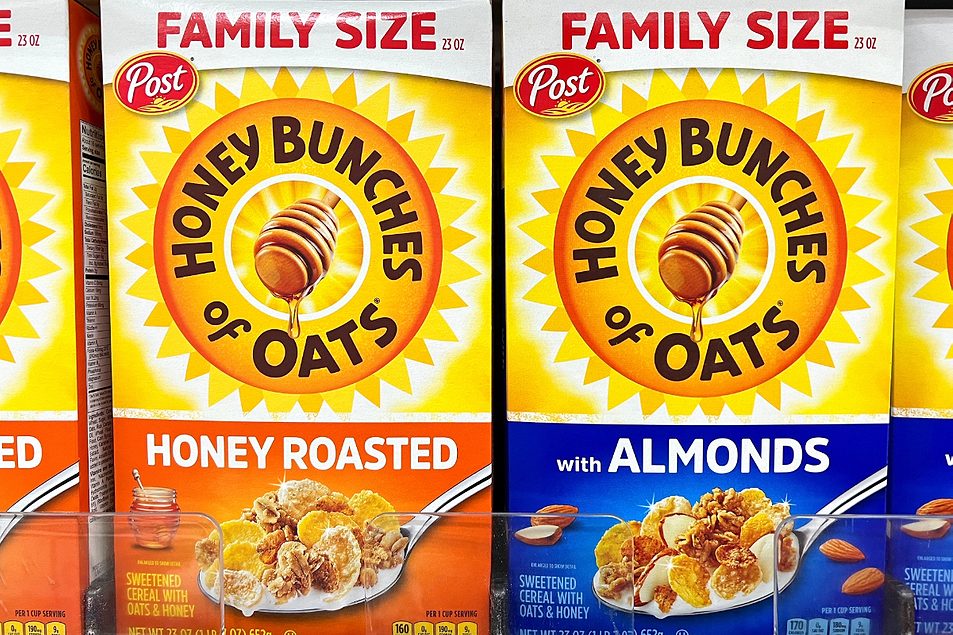
Post Consumer Brands — focused mainly on North American ready-to-eat cereal, pet food and peanut butter — saw first-quarter net sales climb 15% year over year to $1.1 billion, lifted by $217.2 million in sales from 8th Avenue. Excluding the acquisition, the business unit’s volume fell 6%. Cereal and granola volumes decreased 5%, reflecting category declines and lower promotional spend, according to Post. Segment profit edged up 0.9% to $132.2 million.
Post said overall cereal category consumption volume was down 2.5% in the quarter but noted that was closer to the long-term trend, which the company called “an encouraging sign of category stabilization and of cereal’s place as a budget-friendly breakfast choice.”
“There was a significant change in trajectory that happened in November/December, and that coincides with SNAP (Supplemental Nutrition Assistance Program),” Nicolas Catoggio, chief operating officer at Post Holdings, said in a Feb. 6 conference call with analysts. “So we see it as an outcome of changes in SNAP and trade-down from other categories to cereal. Peanut butter also improved in the same period. For now, we see it as trade-down. We need to see what happens in the next few months to actually have the confidence that it’s a change in the category.”

Post’s adjusted EPS of $2.13 for the first quarter topped analysts’ high-end estimate of $1.79.
| Photo: ©JHVEPHOTO – STOCK.ADOBE.COMLess promotional spending and price-pack architecture changes were behind a 4.1% decrease in branded cereal consumption volume for Post Consumer Brands, while a ramp-up in competitor branded promotions squeezed Post’s private label volume. Still, the company said it upheld dollar share for branded cereal despite a “minor decline” in pound share.
“We are adjusting our assortment in channels that are more promotional-driven to increase our efficiency, and as we adjusted the assortment on shelf, we decided to promote less just to avoid disruptions,” Catoggio said. “Longer term, we don’t see a change in our strategy. We will continuously assess opportunities to invest and, if we see a return, we’ll go for it.”
He added, “What we see as very positive is our dollar market share was flat year over year, and that’s what we want.”
Side dishes provide lift
In Refrigerated Retail, net sales came in at $266.6 million for the first quarter, flat versus the prior-year period. Volume dipped 0.2%, as decreases for egg and sausage products were partially offset by a gain in side dishes, lifted by the rollout of private label items, Post said. Segment operating income grew 26% to $30.4 million.
Matthew Mainer, chief financial officer, said Post has seen “a good early start” for its new private label business in Refrigerated Retail.
“We’ve got that in two customers — really two offerings, mashed potatoes and mac and cheese,” Mainer said. “We continue to see a nice pipeline of opportunities to expand that business. But for this year, it’s providing definitely some growth on our dinner sides and adding to price points similar to what we’ve seen at PCB (Post Consumer Brands). Having that alternative, especially in that category, we think will be really beneficial long term and uses some of the excess capacity we have across the network.”
Foodservice net sales advanced 9% to $669.1 million, including the addition of $6.6 million in sales from PPI. Excluding the acquisition, volume rose 8%, which Post attributed to improvement in customer service levels and production of protein-based shakes. Segment profit surged 37% to $117.5 million.
The Weetabix unit — mainly ready-to-eat cereal, muesli and protein-based shakes in the United Kingdom — tallied first-quarter net sales of $137.9 million, up 8% from a year earlier, aided by a 400-basis-point foreign exchange tailwind, Post said. Operating income for the segment rose 37% to $21.7 million.
In response to an analyst question, Robert Vitale, president and chief executive officer, said the recent release of the final 2025-30 Dietary Guidelines for Americans doesn’t materially change Post’s approach to managing its product portfolio. The new Dietary Guidelines flip the old food pyramid by promoting greater consumption of protein — notably meat and full-fat dairy — while de-emphasizing the intake of grain-based foods.
“I think our portfolio is pretty well-balanced with the Guidelines,” said Vitale, who earlier in the call commented that “M&A becomes a much more interesting measure” once multiples come down.
“We are obviously going to consider the nutrients, but also the price from an M&A perspective,” he said. “So I would say once we get closer to where the values are, we’ll have a position on how the (new) pyramid implicates us.”
Citing the first-quarter performance and higher normalized earnings for Foodservice, Post raised its 2026 fiscal year guidance, lifting its adjusted EBITDA projection to $1.55 billion to $1.58 billion from its previous estimate of $1.5 billion to $1.54 billion. The company maintained its 2026 capital expenditure forecast of $350 million to $390 million, which includes spending of $80 million to $90 million for the Foodservice unit’s precooked egg facility expansion in Norwalk, Iowa, and ongoing cage-free egg facility expansion.
#Post #sees #encouraging #signs #cereal
About the Author