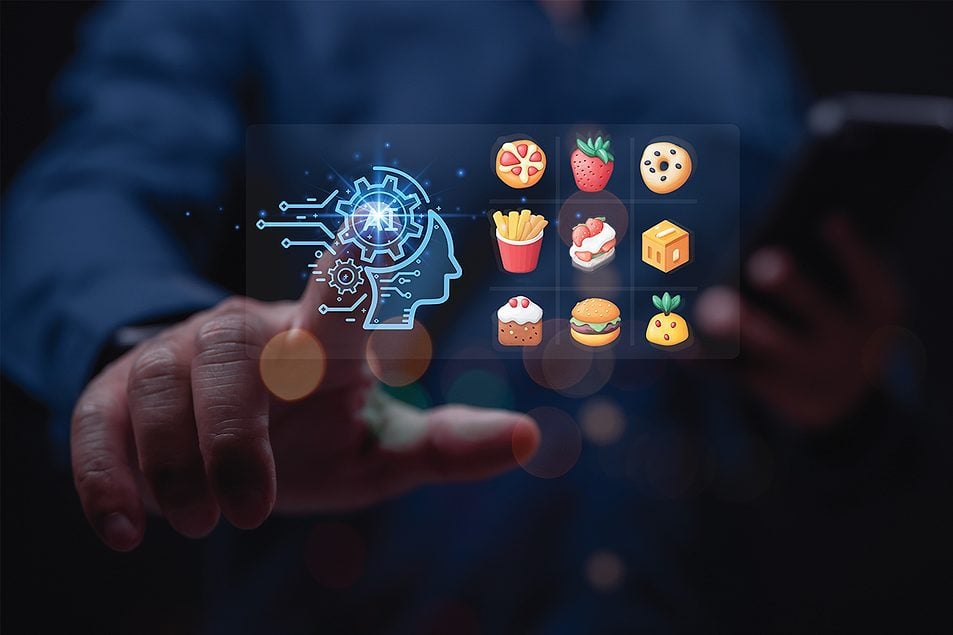
KANSAS CITY — The food and beverage industry is more frequently adopting the use of artificial intelligence (AI) in the development and scale of new ingredients and finished products, as well as assisting with sensory tests and prototypes.
“Food is inherently human; innovation must stay human led, with AI as an enabler,” said Nicholas Ferraro, director-commercial, global differentiated services, Ingredion Inc., Westchester, Ill. “Used in the background, AI turns data into insight without displacing creativity, preserving the trust and connection consumers expect.”
Some ingredient suppliers also say AI helps them work faster and more efficiently behind the scenes, which potentially helps customers get new products to market faster.
“(AI) can help accelerate experimentation, identify patterns in development and testing, and reduce trial-and-error during the formulation process,” said Veronica Cueva, senior vice president, research, development and solution innovations, Tate & Lyle, Hoffman Estates, Ill. “The ideation, creativity, sensory judgment and understanding of consumer preferences all still come from people.”
Thom King, chief innovations officer, Icon Foods, Portland, Ore., added, “Instead of slogging through one-variable-at-a-time bench work, we can now run scenarios before we even crack a bag of ingredients. AI can flag solubility issues, temporal gaps, off-notes, even stability risks before you burn time and money. It doesn’t replace experience. It sharpens it. You’re not guessing anymore.”
King said AI “gets fun in messy systems.” For example, he said sugar reduction is not just about replacing sweetness, but includes replacing solids, monitoring water activity and freezing point, and influencing texture and mouthfeel. In some systems sugar impacts browning, so that must be addressed. Then depending on the replacement ingredients, gut tolerance and labeling must be considered.
“Pull one lever, three others move,” King said. “AI is very good at seeing those connections fast. It can propose stacks. Fiber backbone, rare sugar for bulk, high-intensity sweetener for top note, modulators to clean up the finish. Now instead of 30 bench trials, you’re running five that actually matter.”
King said he treats AI like a junior formulator who still needs a bit of supervision.
“I feed it real formulation data, not theory, and I use it to build starting frameworks, stress-test ideas and call out where things are likely to break,” he said. “It pulls data from over 1,000 formulas I have created over my time formulating. Then I take it to the bench and let reality keep us honest.
“The next move is placing this directly into our website. A formulator is able to pick an application, dial in targets and get a clean label base formula with usage ranges and functional logic behind it.”
The need for human expertise
“Human expertise remains essential to ensuring the solutions we develop meet real consumer needs and expectations,” said Abhishek Roy, senior director for global digital and AI, Cargill, Minneapolis. “We’re using AI as an engine for innovation, expanding the speed and scope of what’s possible, while relying on our experts for final analysis and application.”
Roy cited the example of “AskEmma,” Cargill’s AI-enabled ideation tool. It draws on a large internal library of concepts, trend data and insights to help teams develop personas, identify needs and generate idea starters for customer collaboration.
“Work that once took weeks can now happen in a fraction of the time, enabling our teams to focus on refining and advancing the strongest ideas,” Roy said. “We’re also using AI-enabled ingredient informatics and sensory science innovations to compress formulation cycles from months to days, enabling teams to explore more options before costly bench prototyping. This includes tools that allow us to predict sweetener blend performance and sensory perception across applications, accelerating prototype validation.”
AI supports scalability, too, by connecting research and development decisions with manufacturing, supply chain and cost considerations early in the process.
There are many aspects to reformulating a product for sugar reduction. AI can assist with shortening the amount of bench trials needed to reach desired results/
| Photo: ©NADZEYA – STOCK.ADOBE.COM“This allows teams to design solutions that are both innovative and feasible at industrial scale,” Roy said. “With AI supporting our teams, it frees them to focus on high-value work like defining customer challenges, refining solutions and delivering successful applications.”
Ingredion is piloting an AI-assisted program with select customers globally, enabling faster, more accurate prototyping through the use of AI and proprietary consumer-liking data.
“The value of AI is not speed alone, but sharper learning that strengthens collaboration with customers,” Ferraro said. “AI helps teams manage growing complexity while keeping people at the center of creativity and trust.”
Cueva said, “At Tate & Lyle, one of the most exciting examples of AI-supported innovation is ALFIE, our Automated Laboratory for Ingredient Experimentation in Singapore. ALFIE combines robotics, predictive modeling and advanced data analytics to help our scientists evaluate ingredient combinations and mouthfeel performance at a speed that simply was not possible in traditional food research and development environments.
“ALFIE can run characterization testing roughly 10 times faster than conventional methods, allowing us to speed up formulation development and help customers move from concept to prototype much more quickly and affordably. It’s especially powerful in areas like mouthfeel, where even small formulation changes can dramatically impact texture, creaminess, stability or sensory experience, for example.”
New uses for AI
Another practical aspect to AI is that it can help scientists around the world work in collaboration.
“ALFIE is a good example of that,” Cueva said. “Our teams in Singapore, our North American headquarters and labs throughout the world can collaborate virtually in real time, sharing data, insights and experimentation.”
The future of AI also may be driven by how people eat, cook and engage with food. Advancements in household food preparation and cooking technologies, for example, can impact product development. These technologies can give people more ways to personalize, prepare and experience food.
“As behaviors evolve, AI can help translate how food is being made and enjoyed at home into new product ideas and formats,” Ferraro said. “Innovation opportunities will also come from a broader set of expectations around health priorities, sustainability goals, sensory preferences and eating occasions.”
Another space where AI may be gaining traction is in the upcycling of side streams. MeNow Ltd., Tel Aviv, Israel, showcased how its AI-based technology is capable of identifying potential active compounds from natural sources, including waste streams, at the recent Vitafoods Europe 2026 tradeshow in Barcelona.
“The most valuable ingredients are already being grown, but are often considered waste,” said Hilla Ben-Hamo, chief executive officer and co-founder of MeNow. “There are so many natural compounds out there that can address specific issues, but it takes time to find them and move forward with product development.
“What we are doing here is accelerating this process with AI.”
Overall, Roy said that AI has the potential to fundamentally reshape how innovation happens in food, but only if it’s fully integrated into how companies operate.
“The biggest gains won’t come from isolated tools,” he said. “They’ll come from rethinking workflows end-to-end, so AI can remove friction across the entire development process rather than shifting bottlenecks from one step to another. The companies that will lead are the ones that combine strong technical capabilities with human expertise, clear governance and a culture that treats AI as a valuable tool, not a one-off solution.”
#evolving #innovation #tool
About the Author