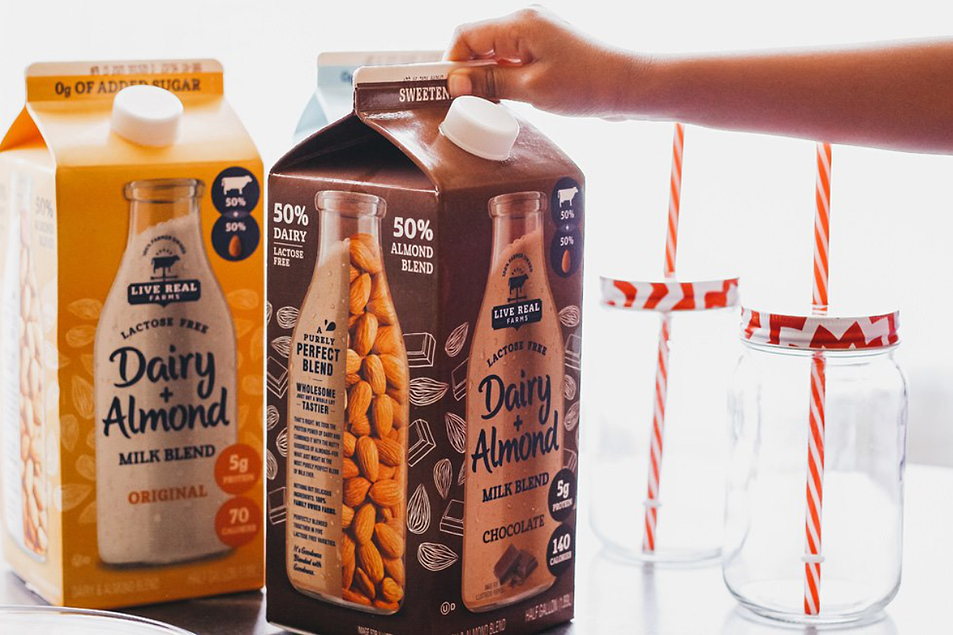
CHICAGO — Combining animal and plant proteins in applications is becoming a more significant consideration as product developers seek to add a sustainability attribute to a product or reduce overall costs.
The Balanced Protein Consortium, San Francisco, is promoting the practice of combining proteins and defines a balanced protein product as one that substitutes 30% of the animal-based ingredients in a product for ingredients sourced from plants.
Dairy manufacturers have tried unsuccessfully to bring balanced protein products to market. In 2019, for example, Dairy Farmers of America, Kansas City, Kan., introduced Live Real Farms Dairy Plus Milk Blends. The company used a blending process to combine cows’ milk with either almonds or oats. Lactase was added to make the beverage lactose free for those with intolerances to milk’s inherent sugar. Sampling was key to the brand’s strategy, but the pandemic halted the effort and the company later ceased production.
Shamrock Farms, Phoenix, introduced Swirled at the beginning of 2021. The chocolate milk alternative was a blend of dairy and plant-based ingredients. The company marketed the beverage as an indulgent hybrid offering featuring the best of both worlds — with chocolate milk and the reduced sugar and healthy fats found in coconut cream and almonds. Shamrock Farms was targeting plant-curious or plant-based consumers who crave the benefits and taste of real milk. It, too, had a short retail presence.
The products may have been too early for consumers to appreciate how diversifying protein sources can benefit themselves and the planet. But that may be starting to change.
“Conventional dairy contains some of the highest carbon-emitting food products on the market due to its reliance on resource-intensive ruminant animals, such as cattle and sheep,” said Caroline Cotto, director of Nectar, a non-profit group focused on accelerating the transition to companies using more plant-based and alternative proteins in formulations. “Balanced dairy offers a practical bridge to a more sustainable food system by meeting consumers where they are: delivering familiar, nutritious and versatile products that can help reduce reliance on animal ingredients without compromising on taste or price.”
For product developers looking for successful examples of applications that combine animal and plant proteins, Europe, particularly Scandinavia, may be the place to start.
PlanetDairy, Aarhus, Denmark, produces and markets hybrid milks and cheeses. The company’s pizza mix is 31% plant-based ingredients, namely starches, plant-derived oils and fava bean protein. The mozzarella content is 40%. There’s also milk protein in the product.
The four-year-old company was founded by three former dairy executives who were convinced that there is a better way to give people all the benefits of the full dairy experience while also adding a sustainability attribute. The first product developed by the company was a beverage that comes in three varieties: skim, semi-skimmed and whole fat. They are 60% to 70% cows’ milk, depending on variety, with the balance comprised of plant-derived ingredients.

To succeed in the development of balanced dairy products, R&D teams need to increase the richness of dairy-associated flavors, such as fattiness and buttery, and at the same time, reduce off notes such as chemical flavors and lingering aftertaste, said Caroline Cotto of Nectar.
| Photo: ©SCOTT HABERMANN – STOCK.ADOBE.COMCheesepop Food Group, Utrecht, the Netherlands, offers hybrid cheese blocks for foodservice. The product is more than half real cheese with the rest being a plant-based analog. The cheese is intended to provide cost savings for foodservice operators.
But, like the United States, Ireland was not ready for blended products two years ago. Kerry Dairy Consumer Foods, a division of Kerry Group’s dairy business Kerry Dairy Ireland, had launched oat- and dairy-blended products under the brand name Smug. Products included milk, cheese and butter, which were described as combining “the goodness of dairy and plants.”
The Smug Dairy portfolio had 40% less saturated fats and saved up to 54% less carbon dioxide emissions per kilogram than traditional dairy. Unfortunately, the consumer was not ready for it.
Nectar used several European hybrids to recently conduct a taste test with 2,100-plus American adults this past year. The results provide guidance on how to develop the category.
“Nectar’s initial review of balanced dairy’s sensory performance provides an encouraging signal,” Cotto said. “Balanced dairy products are beginning to close the gap in overall liking compared to conventional dairy benchmarks.
“Performance gaps and weak consumer perceptions indicate that further work is needed both in product development and communications for balanced dairy. For product development and R&D teams, there’s a need to increase the richness of dairy-associated flavors, such as fattiness and buttery, and at the same time, reduce off notes such as chemical flavors and lingering aftertaste. For consumer insights and marketing teams, anchor messaging in the familiarity of conventional dairy formats. Develop sharper positioning that speaks to specific consumer needs and motivations.”
The global dairy market is valued at nearly $1 trillion. Balanced dairy products have the potential to capture a meaningful share by matching or exceeding the performance of conventional dairy, while communicating how product compositions enhance the familiar applications consumers already know and trust, Cotto said.
#balanced #dairy #category #ground
About the Author