Unlock the Editor’s Digest for free
Roula Khalaf, Editor of the FT, selects her favourite stories in this weekly newsletter.
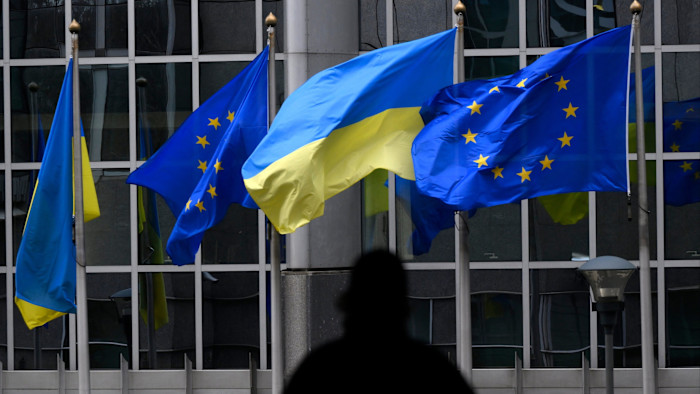
Germany and France have called for Ukraine to be granted “symbolic” benefits in a pre-accession phase that excludes EU farming subsidies and voting rights, falling short of Kyiv’s hopes of fast-track membership following a potential peace deal with Russia.
President Volodymyr Zelenskyy seeks EU membership as one of the key benefits from any peace deal, arguing for his country to join the bloc as early as 2027. But the EU’s biggest members have balked at the European Commission’s proposals to rip up the slow and bureaucratic accession process in order to give Kyiv rapid benefits.
German and French proposals laid out in separate documents seen by the FT pour cold water on any hopes in Kyiv that the war-torn country could be granted privileged status in its bid to join the bloc.
Germany is pushing for “associate membership” status — where Kyiv would sit in ministerial and leaders’ meetings but have no voting rights and “no automatic application” of the shared EU budget.
France dubs such a halfway membership “integrated state status”, under which access to the “Common Agricultural Policy and European funding such as cohesion policy . . . should be postponed to a post-accession phase”.

The recent election defeat of Hungary’s Prime Minister Viktor Orbán, who vetoed the opening of membership talks with Ukraine, raised some hopes of progress. But a large majority of EU members harbour deep fears that granting Kyiv and other candidates fast-track accession would upend the bloc’s political dynamics and undermine the value of membership.
The broad thrust of the papers is “likely” to be close to the EU’s final proposal to Ukraine, two senior Commission officials told the FT.
Taras Kachka, Ukraine’s deputy prime minister for European integration, told the FT: “We are in contact with [Paris and Berlin] and other capitals as well — everything is evolving. There are other papers as well.”
But another Ukrainian official said Kyiv was wary of any watered-down membership concept being seen as a poor substitute for true membership by a war-weary population, but accepted that some elements could be useful.
“We call it ‘shadow membership’,” the official said.
A third Ukrainian official said: “Those guys . . . have to understand that they need Ukraine, too. If they want real security, they have to give [a] fair offer.”
The Franco-German proposals come after almost widespread rejection of the Commission’s proposed “reverse enlargement” concept granting Ukraine full membership without having met all EU criteria, and then gaining financial and other benefits incrementally as those milestones are reached on various policy areas.
The essential difference between the Commission idea and the Paris and Berlin concepts revolves around when Ukraine can call itself an EU member and gain the power to vote in the bloc’s decision-making councils.
Germany’s proposal says the new status would carry “symbolic strength through the name”, and could be granted through a political decision of EU leaders which would sidestep “lengthy procedures”.
“Beyond its symbolic value, this new level of gradual integration would allow for highly visible progress for the citizens of the candidate countries concerned,” the French paper states.
France requires a referendum ahead of each new EU member joining the bloc. Some leaders are wary of such a discussion ratcheting up ahead of next year’s French presidential election, with far-right frontrunners potentially playing up French farmers’ concerns.
Substantial EU agricultural subsidies under CAP and regional funds — which together make up about two-thirds of the existing EU budget — would be “postponed to a post-accession phase”, Paris wrote.
A lighter membership version would, however, include the EU’s mutual defence clause, which is seen as one of the key benefits for Kyiv, given that Nato membership is off the table for the foreseeable future. Such a clause “could be made de facto applicable through a mere political declaration”, the German paper states.
But there would be “no automatic application of the budget”, instead countries such as Ukraine would be gradually phased in EU funding programmes “in accordance with the negotiation progress and with transitional rules”.
As countries progress down the accession path — a lengthy process requiring candidates to reform and integrate the so-called EU acquis or body of law that forms the bloc’s legal blueprint — they would be granted “enhanced access to EU funding programmes”, the French wrote, citing the student exchange programme Erasmus+ and public-private partnerships on digital investments.
Crucially, both countries stress that this lighter version is not an alternative to full membership but an “easy-to-implement substantial shortcut towards it”, in Berlin’s words, which would “play an accelerator role towards it”, as Paris put it.
#France #Germany #plan #symbolic #membership #benefits #Ukraine
About the Author