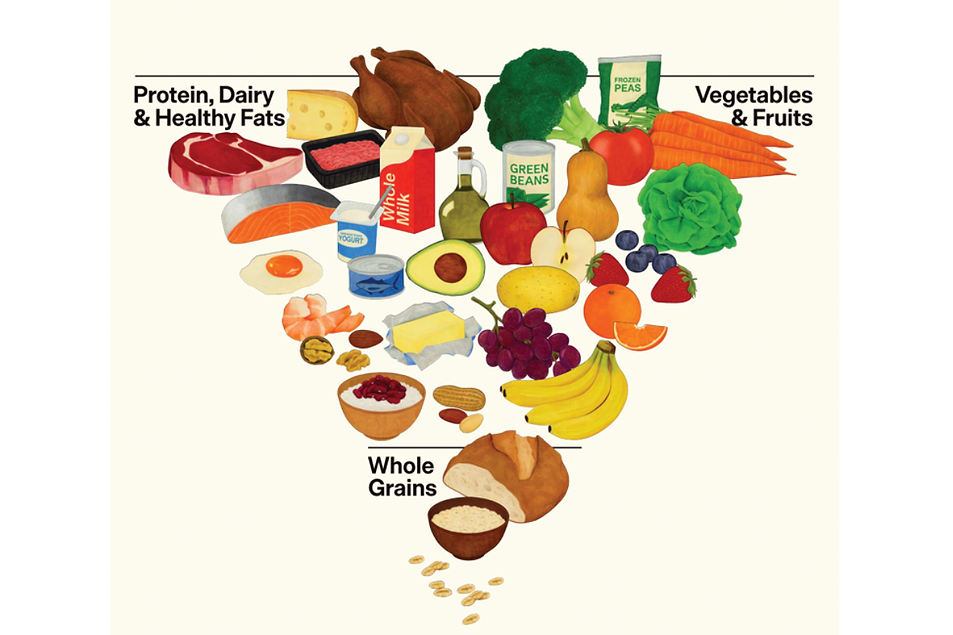
WASHINGTON — The Dietary Guidelines for Americans 2025-2030 released Jan. 7 upended several recommendations from a Dietary Guidelines Advisory Committee (DGAC) and flipped the old food pyramid upside down.
Unlike the previous pyramid, which was replaced by MyPlate over a decade ago, the new pyramid places the food that should be consumed the most at its flat top: nutrient-dense protein from animal and plant sources; healthy fats from whole foods such as eggs, seafood, meats, full-fat dairy, nuts, seeds, olives and avocados; and vegetables and fruit.
The new pyramid has whole grains at the pointy bottom, promoting two to four servings a day, and it leaves out refined grains entirely. In the old pyramid, bread, cereal, rice and pasta were at the bottom base, with recommendations of 6 to 11 servings per day.
“These Guidelines return us to the basics,” said Robert F. Kennedy, Jr., secretary of the Department of Health and Human Services (HHS). “American households must prioritize whole, nutrient-dense foods — protein, dairy, vegetables, fruits, healthy fats and whole grains — and dramatically reduce highly processed foods. This is how we make America healthy again.”
The HHS and the US Department of Agriculture update the Dietary Guidelines every five years.
Promoting protein
The new Dietary Guidelines recommend eating 1.2 grams to 1.6 grams of protein per kg (2.2 lbs) of body weight per day, up significantly from the previous recommendation of 0.8 grams per kg.
“We are pleased the Dietary Guidelines recommend Americans prioritize protein and that families can get that protein from nutrient dense meat and poultry,” said Julie Anna Potts, president and chief executive officer of the Meat Institute. “(USDA Secretary Brooke) Rollins and Secretary Kennedy’s leadership have simplified the Dietary Guidelines, making it clear that meat is a protein powerhouse that plays a vital role in healthy diets.
“Robust scientific evidence demonstrates that meat is a rich source of high-quality protein, essential vitamins and highly bioavailable minerals that support human health throughout the lifespan.”
Healthy fats support brain health, hormone function and nutrient absorption when consumed in natural forms, according to the US government’s realfood.gov website. The new Dietary Guidelines recommend three servings of vegetables and two servings of fruit per day.
The previous Dietary Guidelines recommended three servings of whole grains and three servings of refined grains daily. The new Dietary Guidelines recommend that consumers should prioritize fiber-rich whole grains and reduce consumption of highly processed carbohydrates.

The new Dietary Guidelines will not emphasize intakes of beans, peas and lentils while reducing intakes of red and processed meats.
| Photo: ©ELENA SCWEITZER– STOCK.ADOBE.COM“The updated Guidelines place an emphasis on whole grains, which aligns with long-standing public health goals,” said Erin Ball, executive director of the Grain Foods Foundation. “However, the Guidelines de-emphasize grains overall, and the guidance does not recommend refined and enriched grain foods — thus ignoring their role in nutrient delivery, affordability and how baked goods function in everyday eating patterns.”
Fifty percent of Americans have prediabetes or diabetes, 75% of adults report having at least one chronic disease, and 90% of US health care spending goes to treating chronic disease, according to realfood.gov. The website placed much of the blame on processed foods.
“For the first time, we’re calling out the dangers of highly processed foods and rebuilding a broken system from the ground up with gold-standard science and common sense,” the website said.
Going against the DGAC
Normally, the Dietary Guidelines take the findings of the DGAC into account. This time the administration of President Donald Trump did a supplemental scientific analysis of the 2025 DGAC report, which was finished during the Biden administration. The analysis found that the DGAC advocated plant-based dietary patterns, deprioritized animal-sourced proteins and favored high-linoleic acid vegetable oils.
The new Dietary Guidelines do not implement several DGAC recommendations, including emphasizing the intake of beans, peas and lentils while reducing intakes of red and processed meats, and emphasizing consumption of low-fat or non-fat dairy and unsaturated fats.
“The new Dietary Guidelines send a clear and powerful message to Americans: Dairy foods belong at the center of a healthy diet,” said Michael Dykes, DVM, president and CEO of the International Dairy Foods Association. “IDFA applauds HHS and USDA for grounding the 2025–2030 DGA in today’s nutrition science, including the evidence showing that dairy products at all fat levels support healthy eating patterns.”
The new Dietary Guidelines will “partially” implement the DGAC report’s recommendation to limit foods and beverages higher in saturated fat and to limit total saturated fat intake to less than 10% of calories per day, starting at age 2, by replacing it with unsaturated fat, particularly polyunsaturated fatty acid.
The new Dietary Guidelines also implement several other DGAC recommendations, including limiting foods high in added sugars and emphasizing intakes of iron, folate/folic acid, iodine and chlorine among pregnant and postpartum individuals. The new pyramid encourages avoiding added sugars entirely, especially for children, while allowing naturally occurring sugars found in whole fruits and plain dairy.
“The administration pledged the new Dietary Guidelines for Americans would deliver fresh, simple, comprehensive, science-based guidance,” said Courtney Gaine, PhD, president and CEO of The Sugar Association. “Instead, the 500 pages of new materials released today reflect outdated rhetoric about added sugars that are anything but simple and are inconsistent, unrealistic and lacking scientific support. These Guidelines and accompanying rhetoric will not make Americans any healthier. In fact, added sugars intake has already plummeted 30% over the past two decades, while obesity has spiked by 40%.”
#Protein #stands #atop #Dietary #Guidelines #Americans
About the Author